
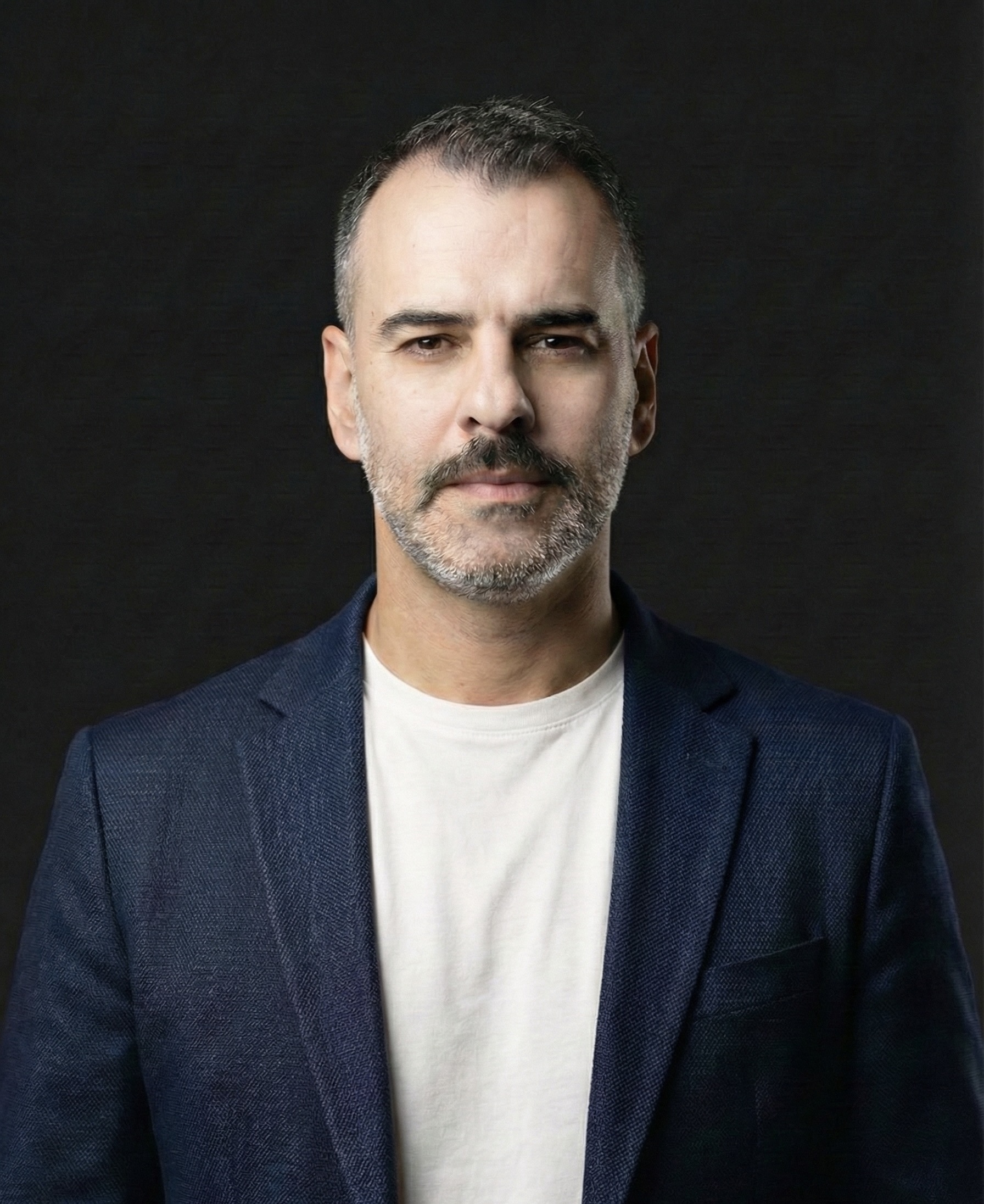
// about
Technology is never only about technology.
Background
I have spent the past two decades working at the point where technology strategy, engineering and commercial reality meet.
My background spans enterprise infrastructure, cloud, automation, artificial intelligence, product development and go-to-market strategy. I have worked with senior business leaders, architects, engineers, commercial teams and operators, often translating an ambitious technology idea into something that can be funded, built, governed, adopted and measured.
I have always been more interested in what sits behind the polished interface: the architecture, infrastructure, economics, operational constraints and human decisions that determine whether a technology creates lasting value or becomes another expensive experiment.
Products I have built, end to end
Alongside Silicon Tales, I design and build AI products of my own.
I have taken Loomiks.ai and BeeCool.ai from a blank page to working products. On both, I am the architect, and I have owned every stage of the product lifecycle myself: product strategy, product roadmap, product design and product delivery.
Loomiks.ai
Turns enterprise AI ambition into governed decisions, AI factory designs and delivery plans, connecting board-level priorities with the engineering reality beneath them.
loomiks.aiBeeCool.ai
Turns a website into on-brand images and videos. From a single web address it learns a brand’s identity, products and visual language, so everything it creates already looks like that brand.
beecool.aiEnd to end meant owning five disciplines and the trade-offs between them:
- 01 Architecture The system design, the model and infrastructure choices, and how the product behaves when something fails.
- 02 Product strategy Who it serves, which problem is worth solving and where durable value sits.
- 03 Product roadmap What ships first, what waits, and how each release earns the right to the next.
- 04 Product design The whole experience, down to details no user should have to think about.
- 05 Product delivery Building, testing and shipping it, then keeping it dependable in production.
Strategy, architecture, design and delivery never changed hands. They were one continuous responsibility.
That shapes how I write. When I look at an AI platform or a new layer of infrastructure, I read it the way a builder would: which architecture decisions will be hard to reverse, what each model call really costs, which bets the roadmap is making and what it takes to keep a product dependable once people rely on it.
Silicon Tales is my independent editorial project
I created it to explore the deeper stories behind semiconductors, artificial intelligence, computing infrastructure and engineering: not simply what has been announced, but what has to be true for it to work.
A new processor is never only a processor.
It is also a manufacturing, energy, supply-chain, software and geopolitical story.
A new AI model is never only a model.
It is also a story about infrastructure, inference economics, data rights, reliability, organisational design and accountability.
An announcement is never a running system.
A data-centre announcement is not the same thing as energised, usable capacity. A benchmark result is not the same thing as a reliable production outcome. And deploying more agents does not automatically mean creating more value.
That gap, between technological possibility and operational reality, is where I spend most of my time.
What I am focused on now
My current focus is the industrialisation of AI.
I see an AI Factory not simply as a collection of GPUs, models, software platforms or AI agents. It is an operating system for converting capital, energy, data, engineering and human judgement into dependable business and societal outcomes.
From that perspective, token volume, model count and the number of deployed agents are not the primary metrics a Board should follow. The more useful north-star metric is:
north-star metric Cost per reliable completed outcome
In other words: what is the total cost of producing a result that is accurate enough, safe enough, timely enough and operationally complete?
That question forces a more serious discussion about AI economics and performance. It requires organisations to look beyond demonstrations and activity metrics, and to examine measures such as:
- 01 Revenue and gross profit per megawatt
- 02 GPU and accelerator utilisation
- 03 The gap between announced capacity and energised capacity
- 04 The time required to move from one model or provider to another
- 05 The proportion of exceptions requiring human intervention
- 06 Agent rollback and emergency-stop time
- 07 Revenue growth and cost advantage attributable to AI
- 08 Model, cloud and supplier concentration
- 09 AI-related errors and losses in critical processes
- 10 Data provenance, rights and consent coverage
These are not purely technical measures. Together, they reveal whether an AI strategy is economically durable, operationally resilient and governable at scale.
I am particularly interested in the next strategic layer of the AI economy: the relationship between compute, power, capital, sovereignty, data and organisational control. This includes semiconductor roadmaps, accelerator competition, hyperscale and sovereign AI infrastructure, power availability, data-centre construction, model portability, enterprise AI operating models and the growing tension between technological concentration and strategic independence.
My wider areas of interest include public-sector transformation, defence and national resilience, financial services, life sciences, scientific discovery, local and edge AI, and the longer-term convergence of AI with quantum computing.
Why the past matters
Silicon Tales also looks backwards.
Technology history is often reduced to a simple sequence of winners, losers and product launches. But many of the most important ideas came from companies, engineers and computing platforms that no longer dominate the market, or no longer exist at all.
The stories of early personal computers, graphics pioneers, semiconductor companies and forgotten engineering teams help us recognise patterns that continue to repeat:
- Open ecosystems vs vertically integrated platforms
- Technical superiority vs market timing
- Innovation vs distribution
- Proprietary control vs interoperability
- Capital strength vs engineering ingenuity
- Hype cycles vs real adoption
Understanding those patterns does not tell us exactly who will win the next technology cycle. It does help us ask better questions.
How I approach the work
I write from the practitioner side rather than from the sidelines.
My approach combines technical curiosity, strategic analysis and commercial realism. I am interested not only in what a technology can do, but also in who will pay for it, who will capture the value, which bottleneck it moves, what new dependency it creates and what happens when it fails.
I try to distinguish clearly between verified facts, interpretation and forward-looking analysis. I do not believe every announcement represents a revolution, every benchmark represents progress or every large investment guarantees a viable business.
At the same time, Silicon Tales is not built on cynicism. Technology deserves both curiosity and scrutiny.
The aim is to understand what is genuinely changing, which capabilities are becoming strategically important, where the real constraints sit and how technology affects the people and institutions around it.
Silicon Tales is for readers who want technical depth without unnecessary jargon, strategy without corporate theatre, and optimism without surrendering scepticism.
The objective is not to predict every winner. It is to see the forces clearly enough to understand what is being built, who is shaping it, and what it may eventually ask of all of us.
Short bio
Onur Sirin is a Sr. Technologist, strategist and builder with two decades of experience across enterprise infrastructure, cloud, automation, AI transformation and go-to-market strategy. He writes about the systems, economics and human decisions behind semiconductors, AI infrastructure and computing, focusing on the gap between technological possibility and durable, measurable outcomes. He is the founder of Silicon Tales, an independent editorial technology publication based in the United Kingdom.
Thoughts, corrections or a topic worth digging into? Write to hello@silicontales.com or connect with me on LinkedIn.