
// retro hardware
3dfx and the Voodoo That Taught Us to See
For one impossible stretch in the late nineties, a tiny company made the screen come alive in a way it never had before. Then it made every mistake a market leader can make.

I was sixteen, maybe seventeen. The money for one of the first Diamond Monster cards simply did not exist, not in my pocket and not in the house. So I played the way a lot of us played then. A friend and I would run a serial cable between our two machines, the kind of thin grey lead nobody under thirty has ever seen, and that was our network. No Ethernet card. No Wi-Fi, which would not arrive for years yet. Two PCs, one cable, and a copy of Quake 2 we had both already finished more than once.
My machine was a Pentium running at 120 megahertz, with sixteen or thirty-two megabytes of EDO memory, a 1.3 gigabyte Fujitsu drive, and an S3 Trio that carried all of half a megabyte of video memory. If you lived through it, you already know the punchline. On an S3 Trio, Quake 2 did not so much run as flick past you, frame by frame, flat and depthless, every surface the same dead matte. The S3 Trio and its cousin the Virge had a nickname among the people who knew the difference: 3D decelerators. Cards that somehow made 3D worse.
Then one afternoon my friend turned up with something he had borrowed from a friend of his. A Diamond Monster, four megabytes, a Voodoo. Here, he said. Try it. You can keep it for a day. I had loved Quake 2 with the half-blind devotion you give a thing when you have nothing to measure it against. I slid the card in, ran the pass-through cable, and launched the game I thought I knew by heart.
It was as if I had been blind, and could suddenly see.
The same map. The same monsters. But now the walls held their texture when I moved, the light bled and pooled the way light actually does, and the world had a depth my eyes had been begging for without my ever knowing it. I was not playing a faster Quake 2. I was playing a different medium. That was more than twenty years ago. I have bought a great deal of hardware since, sat through a great many launches, written about most of them. Nothing has ever done that to me again. Not once. No upgrade, no new generation, no "now with ray tracing" has come close to the moment a borrowed card I had to give back the next morning made the screen come alive.
This is the story of the company that built that card, and that feeling, and then threw both away in six short years.

01 / what it actually changed
The thing nobody tells you is how new "PC gaming" really is
If "PC gaming" exists today as a thing people say with a straight face, we owe it, more than to anyone, to 3dfx. Rewind to the middle of the nineties. If you wanted to play games, you did not buy a computer. You bought a console. The PC was the machine you did your homework on, ran your spreadsheets on, and gamed on when you had to. 3dfx flipped that, deliberately and almost overnight. It took the box that could play games if you forced it, and turned it into a box built to play them.
And here is the part the spec sheets will never hold. I am not the only one who remembers the exact moment. Ask anyone who was there and they do not reach for a benchmark, they reach for a feeling.
One reader bought a modest machine with an S3 Virge, then a month later dropped a Diamond Monster beside it. Need for Speed, Tomb Raider 2 and Quake 2 changed in front of his eyes, and he says no computer technology since has matched the shock. It did not arrive as a number on a chart. It arrived shouting.
Another, a teenager in 1997, lugged a PC to a shop with a classmate to fit a Voodoo 2, carried it home cradled like an infant, switched it on, and got a black screen. The despair of that moment, he says, is still vivid. The 2D card had simply been jostled loose on the bouncing walk home. They reseated it, booted Quake 2, walked into the first level, and sat there stunned. He runs a top-end modern card now and has owned every console for two decades. He still has not felt what he felt in 1997.
That is the bar 3dfx set. Not faster. Transformative, in the literal sense, the kind of leap you feel in your chest before you can explain it. Hold that feeling, because it is also the thing the company forgot how to protect.
02 / where it came from
Three engineers, a pile of venture money, and an arcade habit
3dfx Interactive was incorporated in San Jose in August 1994 by three engineers who had walked out of Silicon Graphics: Ross Smith, Gary Tarolli and Scott Sellers, with early money from Gordon Campbell's TechFarm. The following year they raised five and a half million dollars. The context matters. Silicon Graphics built the high-end 3D dreams of the era, it even helped Nintendo bring the Nintendo 64 to life, but it had little interest in cheap graphics for ordinary PCs. Its alumni did. They had seen something their old employer would not chase: a huge market hiding on the PC, hinted at by the early success of shareware games like Doom.
So 3dfx did not start by selling graphics cards at all. It started in the arcades, its first Voodoo silicon powering cabinets like San Francisco Rush and Wayne Gretzky's 3D Hockey. Then, in 1996, memory prices fell, and the company turned its eyes to the desktop. It walked into a market that was pure chaos. There was no Nvidia-and-AMD duopoly then. There was a crowd of chip makers, each pushing its own hardware and, worse, its own software interface, none of them agreeing on anything, all of them fighting to be the standard. Into that noise, 3dfx dropped a bomb.
The whole arc, end to end
Before we get lost in the cards, here is the shape of the thing. Note how short it is. Most companies take this long just to find their feet. 3dfx rose, conquered, and died inside it.
- Aug 19943dfx is founded by three ex-SGI engineers in San Jose. The first customers are arcade makers.
- Nov 1996Voodoo Graphics arrives on the PC and detonates the market. PC gaming, as a real category, begins.
- 1997Voodoo Rush, the first stumble, a 2D and 3D combo that nobody much wanted. Sega picks a rival for the Dreamcast.
- 1998Voodoo 2 and SLI. The competition is flattened. 3dfx owns roughly 85 percent of the market.
- Dec 1998The STB deal. 3dfx buys a board maker for 141 million dollars and cuts off its own partners. The beginning of the end.
- Oct 1999Nvidia's GeForce 256 moves the goalposts. 3dfx answers with the aging Voodoo 3, still stuck on 16-bit color.
- 2000Voodoo 4 and 5, beautiful and too late. The VSA-100 finally brings 32-bit, but the rivals are long gone.
- Dec 2000Sold to Nvidia for about 112 million dollars. Six years after it began, 3dfx is finished.
03 / the voodoo, 1996
It was not a graphics card. That is the part everyone forgets.
Here is the strangeness modern readers trip over. The original Voodoo Graphics did not draw your desktop. It was a 3D-only accelerator that sat beside your ordinary 2D card and did nothing at all until a game asked for 3D. You ran a short pass-through cable out of your 2D card, into the Voodoo, and on to the monitor. In Windows, the picture passed straight through and the Voodoo stayed dark. The instant a game switched to 3D, the Voodoo seized the entire screen, the 2D card went quiet, and a different world appeared.
Now the specifications, which only matter because of what they bought you. Fifty megahertz. Four megabytes of EDO memory. A resolution of 640 by 480, or 800 by 600 if a game was willing to skip the depth buffer. Sixteen-bit color. Full screen only, no accelerated window. On paper, modest, even then. In a darkened room, a different planet. Diamond's Monster 3D was the board most people remember, and the cards arrived at roughly the price of a games console and then sold out everywhere. A distributor in some markets did not even understand what it was selling, and tried to push the thing as a "Windows accelerator." It was that new.
Glide, and the logo you learned to hunt for
The second piece of magic was software. 3dfx wrote its own graphics interface, Glide, the Direct3D of its day but far leaner: fewer than a hundred commands where OpenGL had more than three hundred, talking almost straight to the metal. Games written for Glide ran beautifully, and because so many were, owning a Voodoo became the only way to see a game the way its makers intended. You learned to flip a game box over and look for the 3dfx or Glide logo. If it was there, you were safe. That little mark was a promise.

Overclocking a Voodoo meant editing a line in your autoexec.bat that set the chip's clock. You nudged it from fifty to fifty-seven megahertz, a hair over ten percent, and then you stopped. There was effectively no cooling, and fifty-seven was the unspoken ceiling nobody sane went past. And every time the card woke for a game, it flashed a little boot logo, a welcome to the 3D world splash, that genuinely thrilled people. Two and a half decades later, the modern Nvidia logo that flickers before a game does exactly the same job to your nervous system.
04 / the first stumble
The card nobody bought, and the console it lost
In 1997, drunk on success, 3dfx tried something clever and got it wrong. The Voodoo Rush folded a 2D core onto the Voodoo so you would not need two cards anymore. It did not work. The two halves fought over the same memory, performance sagged, and the board was big and strange, carrying video input, support for stereoscopic 3D glasses, and a composite video output that almost nobody wanted. Hardly anybody bought it. In a run otherwise blessed, the Rush is the one card 3dfx fans remember with a wince.
Around the same time, a door to a completely different future swung shut, quietly. 3dfx wanted the Sega Dreamcast badly and pitched hard for it. Sega chose a PowerVR design, built by NEC, instead. 3dfx sued. It would not be the last time the company's pride did its talking for it, and it would not be the last time pride cost it dearly.
05 / the death blow
Voodoo 2: not a reinvention, a knockout
The Voodoo 2 of 1998 did not reinvent anything. It took the Voodoo and turned every dial up. Ninety megahertz instead of fifty. Eight or twelve megabytes instead of four. Two texture units to the original's one, so it could lay down two textures in a single pass. A clean 800 by 600. And it carried a word into our vocabulary that has never quite left: SLI.
Run a second Voodoo 2, link the pair with a little ribbon that looked exactly like a floppy drive cable, and the payoff was not more frames. It was resolution. 1024 by 768, which in 1998 felt the way 4K feels now, an almost indecent sharpness. By the time the Voodoo 2 landed, the whole ecosystem had grown up around 3dfx. Every game supported it. The confusion of the early days was over, and so, it seemed, was the competition.
The brand ran so hot that the hype tipped into farce. With the card in short supply, some shops took full-price pre-orders by selling the empty box, the actual hardware to follow whenever it arrived. People paid, gladly, for cardboard and a promise. That is the kind of devotion most companies never earn once.
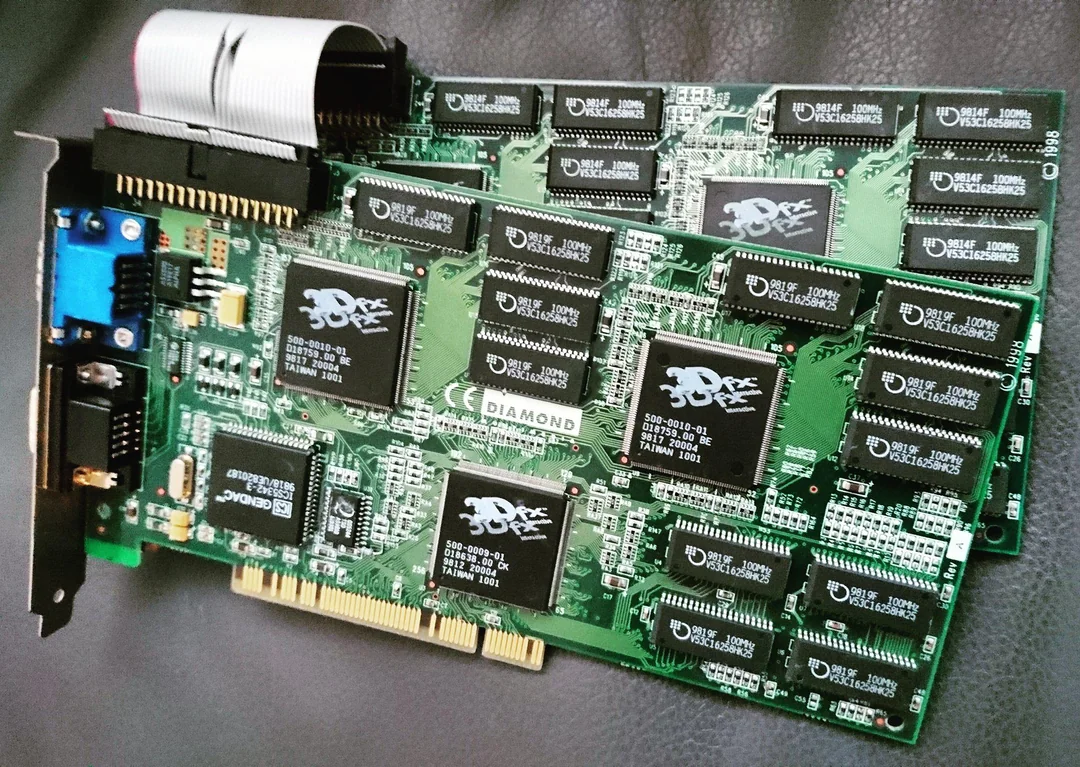
The little SLI bridge outlived the company that invented it. The idea of yoking two graphics cards together became Nvidia's own SLI and, on the other side, ATI's CrossFire, and it shaped how enthusiasts chased performance for the next fifteen years. Not bad for a trick that started life as a floppy cable.
06 / the sensible one
Banshee: the all-in-one that quietly sold a tonne
The Banshee, also in 1998, finally did what the Rush had failed to do: it put a genuinely good 2D core and a Voodoo-class 3D engine on a single chip. It ran at a hundred megahertz, carried sixteen megabytes, and was the first 3dfx part to ride the new AGP slot rather than PCI. It was also the first that could accelerate 3D inside a window instead of only in full screen. Its 2D was excellent, close to the practical limit of the bus.
Its one real compromise was a single texture unit, so it lacked the Voodoo 2's two-at-once muscle. It sold very well regardless, well enough that after the Voodoo 3 arrived, some sellers quietly passed Banshees off as Voodoo 3s with faked drivers. It was never one of the heartbreak cards people pine for. It was the practical one, the card you actually recommended to a friend who just wanted everything to work.
07 / the deal that killed them
The single decision that ended the company was an act of pride
Here is the turn. In December 1998, weeks before the Voodoo 3, 3dfx bought a board maker called STB Systems for a hundred and forty-one million dollars, and announced it would stop selling chips to anyone else. From now on, 3dfx alone would build and sell Voodoo cards, and keep all the margin for itself. Read that again.
The company that had ridden to total dominance on the backs of more than a dozen partners, Diamond, Creative, Orchid and the rest, told every one of them, on the same day, that they were cut off. They did not sit and sulk. They walked straight across the street to a hungry young company called Nvidia, and to ATI, and they brought their factories, their distribution and their shelf space with them. In a single stroke, 3dfx converted its entire partner network into its enemy's supply chain.
The arrogance of believing you could fire every customer and keep the whole business for yourself.
It got worse in the details. STB's card plant sat in Juarez, Mexico, which meant higher costs and, by several accounts, quality problems. The big PC makers 3dfx had hoped to win over flinched, and some would not ship cards built there at all. Almost every postmortem of the company points to this one move. It was not that the engineering failed. It was that the leadership, certain it could not lose, set fire to the very thing that had carried it to the top. Pride, in the end, did what no competitor had managed.
08 / the first gpu
Voodoo 3 sold on a famous name. Then Nvidia changed the rules.
The Voodoo 3, in 1999, was the first card to wear the 3dfx name itself, in those loud boxes covered in painted faces, with a fresh boot animation to replace the old one. It was a fine card, and on the strength of the brand alone it sold and sold. But its bones were old. It still capped textures at 256 by 256 where the competition reached far higher. And, most damning, it still pushed only 16-bit color out to the screen. 3dfx insisted its special filtering made sixteen bits look like twenty-two. The reviewers raised an eyebrow and wrote that down.
Because across the table, the ground had shifted under everyone. In October 1999, Nvidia shipped the GeForce 256 and, with a marketer's flourish, called it the world's first GPU. The claim was generous, others had built geometry hardware before, but the substance underneath it was real. It moved transform and lighting, the heavy geometry math, off the CPU and onto the chip itself, and it rendered in full 32-bit color. This was not a faster rasterizer. It was a different idea about what a graphics chip should be: take the whole job onto the silicon. The world moved to that new architecture. 3dfx's feet were still planted in the old one.
3dfx was not the only casualty of the shift. In parallel, S3 bought Diamond, bet everything on a chip called the Savage 2000, fumbled its hardware geometry engine in software, and sank. The late nineties were a graveyard for graphics companies. The market was consolidating fast around the two names that understood where it was heading.
09 / the last, beautiful gasp
The final cards were gorgeous, and far too late
And yet the last act was, in its way, beautiful. In 2000 the VSA-100 chip, codenamed Napalm, finally brought 3dfx up to 32-bit color, and the company did the thing it had always done best: it threw raw silicon at the problem. The Voodoo 4 used one chip. The Voodoo 5 5500 put two on a single board and shared the load between them, a dual-chip card in an age when that was rare. 3dfx pushed anti-aliasing further than anyone, smoothing the jagged edges off every polygon at almost no cost in speed, and the image quality was, frankly, lovely.
The high end was so hungry it needed its own power, a brick that plugged into the wall, half-jokingly known as Voodoo Volt. Laugh if you like, but that is the direct ancestor of every auxiliary power connector hanging off a modern graphics card. 3dfx was, even at the end, inventing the future. It just could not sell it fast enough.
| Card | Year | Clock | Memory | Texture units | Max res | Color out |
|---|---|---|---|---|---|---|
| Voodoo Graphics | 1996 | 50 MHz | 4 MB | 1 | 640×480 | 16-bit |
| Voodoo 2 | 1998 | 90 MHz | 8 to 12 MB | 2 | 1024×768 (SLI) | 16-bit |
| Banshee | 1998 | 100 MHz | 16 MB | 1 | windowed | 16-bit |
| Voodoo 3 | 1999 | 143 to 183 MHz | 16 MB | 1 to 2 | high | 16-bit only |
| Voodoo 5 5500 | 2000 | VSA-100 | 64 MB | 2 chips | high | 32-bit |
The highlighted row is the whole tragedy in one line. By 1999 the Voodoo 3 was still pushing only 16-bit color to the screen while the rest of the industry had moved to 32-bit. The fix arrived with the Voodoo 5 in 2000, a full generation late.
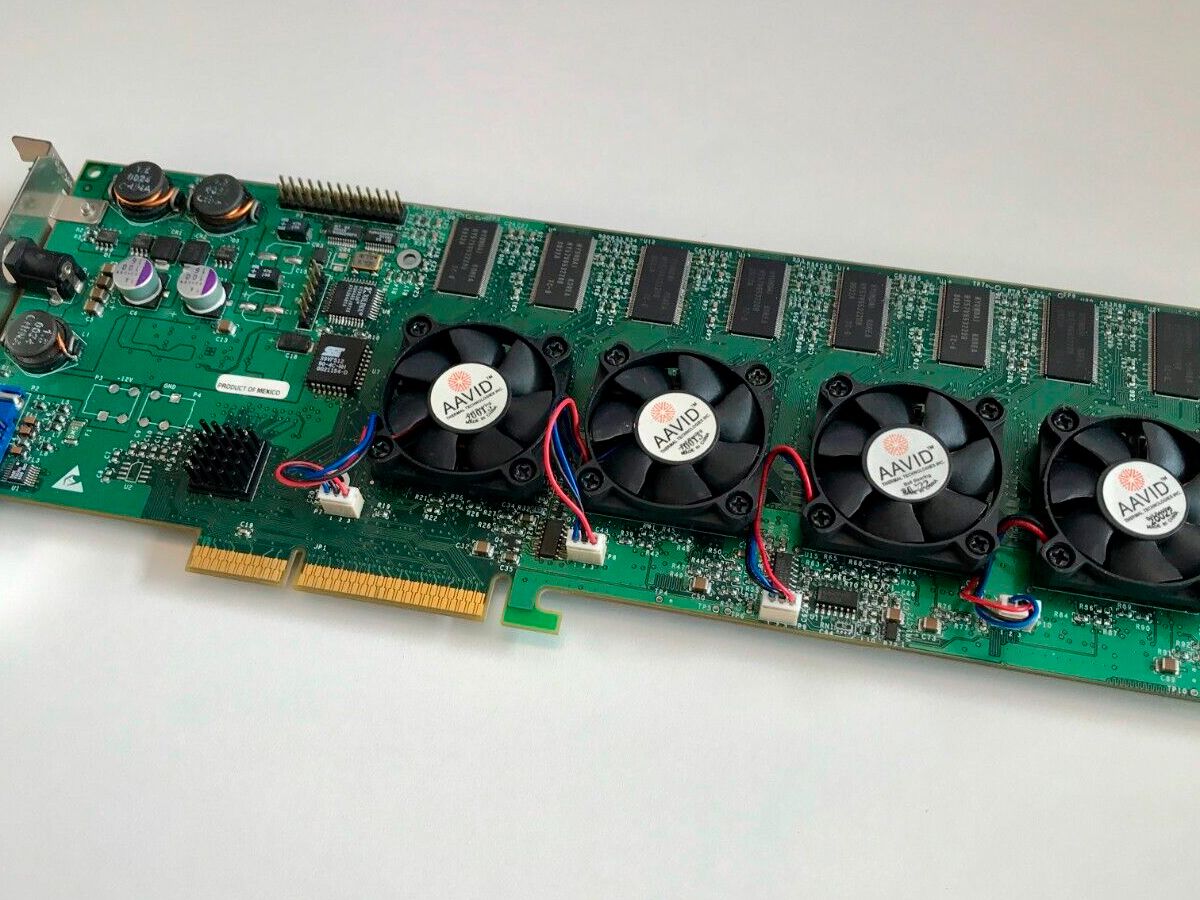
And then there is the one gamers still whisper about: the Voodoo 5 6000. Four VSA-100 chips on a slab of a circuit board, a hundred and twenty-eight megabytes of memory, fed by that external brick, so demanding and so delayed that it never officially shipped. Prototypes survive in collectors' hands and change hands for the price of a used car. None of it saved the company. The cards were expensive and a step behind, the rivals had already moved on to the GeForce 2, and the moat that had made a Voodoo worth buying even when the raw numbers were close, Glide, had run dry. As games standardized on Direct3D and OpenGL, the magic logo on the box stopped mattering.
One reader captures the whole shift in a single regret. He built a new machine in 1999, picked the faster Nvidia TNT2, and only then discovered that his favorite racing game spoke nothing but Glide. So he drove through mud-coloured graphics for years, and did not see the game in proper 3D until a remaster, a full generation later. The Glide lock-in that had once been 3dfx's superpower had become a cage, for the games and the company both.
The deeper criticism, the one 3dfx's own fans still make, is that the company bet on the wrong thing. It treated 3D as a race for raw frames. Nvidia bet that 3D was really about light and shadow and detail, and built the hardware and the APIs to chase exactly that. Both could not be right, and the market sided with Nvidia. There are also claims that 3dfx was never really built to manufacture at scale, that some of its troubles were baked in from the start. Whatever the precise mix, the direction of travel was clear, and it was downhill.
10 / the end, 2000
Free fall, and the card that never came
By late 2000 the company was falling, and behaving like it. It spent a hundred and eighty-six million dollars in stock on GigaPixel, a tiny firm whose own great hope, getting inside Microsoft's first Xbox, had already failed. It began selling off patents to raise cash. The panic was visible from orbit.
And on 15 December 2000, it was over. Nvidia agreed to buy 3dfx's core assets, the patents, the chip inventory, and the 3dfx and Voodoo names themselves, for seventy million dollars in cash and a million shares, around a hundred and twelve million dollars all told. The two quietly dropped the lawsuits they had been throwing at each other. 3dfx laid off essentially everyone, ceased product support within weeks, and would file for bankruptcy in 2002. Six years after it was born, the company that taught the PC to render in 3D was gone.
The cruelest detail is the card that never came. A next-generation chip called Rampage, with a geometry engine called Sage, was to anchor a product line meant to carry the name Spectre. The people who were there swear it was special, the comeback that would have answered the GeForce on its own terms. It died on the workbench, weeks from silicon. It is the eternal what-if of 3D graphics, the ghost in every 3dfx fan's collection.
11 / the afterlife
They say the 3dfx blood still runs in Nvidia's veins
Here is the strange grace note. Nvidia does not, as a rule, destroy what it buys. Think of the companies that have swallowed a beloved name and erased it within a couple of years. Nvidia kept SLI's name alive for two decades. It could have buried Voodoo and instead more or less let the brand rest with its dignity intact. And the people who lived through it will tell you something stranger still: that Nvidia changed after it absorbed 3dfx's engineers, more than a hundred of whom it hired in the deal.
That the combative streak, the appetite for a fight, the obsessive fiddling with drivers, the sharp-elbowed swagger Nvidia is famous for, all of it carries a flavour of 3dfx. They say the 3dfx blood still runs in Nvidia's veins. How literally true that is, nobody can prove. But watch what Nvidia became, the company that now insists it is not a GPU company at all, and the lineage is hard to miss. The hungry challenger ate the fallen king, and started to walk like him.
How badly people wanted in
To understand the company, you have to understand the pull it had on a generation of kids who could not afford it. Two memories say it better than any market-share chart.
One reader was simply too young to have a say. An older cousin had the 3dfx card, and the difference on screen was not subtle, not a setting buried in a menu, but obvious across the room. He wanted it with his whole heart and had no vote in the matter, the way you do not at ten years old. He just watched someone else's Voodoo and ached.
Another saw a game on television, fell for its graphics, scraped together the money, ran home, and started it up, only to be told the game needed a 3Dfx card he did not own. The disappointment lodged in his throat. He had only half the price of one. So he begged the shopkeeper to tell his father the card cost only the little he had saved, and his father, grumbling, bought it. The shopkeeper told his father the truth anyway. The boy, thinking he had pulled it off, finally got the card home, slid it in, launched the game at last, and the thing would not even start. There is the whole era in one small heartbreak: the wanting, the scheming, the cost, and the anticlimax.
The verdict
3dfx is the most important company most people under thirty have never heard of. It took the personal computer, a machine that could play games if you forced it, and turned it into a machine built to play them. If a serious gamer today reaches for a PC over a console, if the fastest gaming hardware on earth lives in a tower and not under a television, the starting gun was a Voodoo card in 1996.
It was also a clinic in how to lose, gracelessly and fast. A leader so certain of itself that it fired its own allies, clung to yesterday's architecture while the world moved on, and mistook brute frames for the whole point of the medium. Both things are true at once. That is precisely what makes it a story and not a spec sheet. The triumph and the self-sabotage are the same company, and you cannot tell one without the other.
And the part the datasheets will never capture is the part I opened with. For one short window, a small company made the screen come alive in a way it never had before and, for a lot of us, never quite has since. 3dfx belongs on the short shelf of beautiful, doomed hardware stories, alongside the doomed brilliance of the Commodore Amiga: too good for its moment, undone as much from the inside as from the market. The cards are relics now. People still keep them, still run dusty SLI rigs on ancient drivers, still pay absurd money for a Voodoo 5 6000 that never officially existed. Not because the hardware is good by any modern measure. Because of what it felt like the first time.
12 / frequently asked
3dfx and Voodoo, quick answers
What was 3dfx and why did it matter?
3dfx Interactive was an American chip company, founded in 1994 by three former Silicon Graphics engineers. Its Voodoo line of 3D accelerators, beginning in 1996, brought arcade-grade 3D to ordinary PCs for the first time and effectively created PC gaming as a category. At its peak it held roughly 85 percent of the consumer 3D market.
Was the Voodoo a graphics card?
Not on its own. The original Voodoo Graphics was a 3D-only accelerator that worked alongside a separate 2D card. A pass-through cable ran from your 2D card into the Voodoo and then to the monitor. In Windows the picture passed straight through, and the moment a game went 3D the Voodoo took over the whole screen.
What was Glide?
Glide was 3dfx's own graphics interface, the Direct3D or Vulkan of its day but far leaner, exposing fewer than a hundred commands where OpenGL had more than three hundred. Because so many games were written for Glide, owning a Voodoo was often the only way to see a game at its best.
Why did 3dfx fail?
Several things compounded. In late 1998 it bought the board maker STB and cut off its hardware partners, who defected to Nvidia and ATI. It clung to 16-bit color and an aging architecture while Nvidia's GeForce 256 moved geometry onto the chip and rendered in 32-bit. And as games standardized on Direct3D and OpenGL, the Glide advantage faded. By the end of 2000 it sold its core assets to Nvidia.
Who owns the 3dfx and Voodoo names now?
Nvidia. On 15 December 2000 it agreed to buy 3dfx's core graphics assets, the patents, the chip inventory, and the 3dfx and Voodoo trademarks, for seventy million dollars in cash and a million shares, around a hundred and twelve million dollars in total. 3dfx then wound down and filed for bankruptcy in 2002.
Can you still use a Voodoo card today?
Enthusiasts do, on period hardware with old drivers, mostly for the love of it. Working cards have become collectors' items, and rarities like the never-released Voodoo 5 6000 fetch serious money at auction. None of them are remotely competitive with a modern card. That was never the point.