
// silicon history
Two Turkish Engineers Built the First GPU. History Gave the Credit to Someone Else.
Years before NVIDIA held up the GeForce 256 and called it the world's first GPU, a small company outside London had already built the chip, won the firsts, and put the word in print. This is the story of 3Dlabs, and of the two men almost nobody remembers.
01 / the word that got taken
The word that got taken
Picture a stage in 1999. The lights come up, a man holds a small green circuit board over his head, and he tells a room of true believers that he has just invented something. He calls it a GPU, a graphics processing unit, and he says it is the first of its kind. The room applauds. The phrase sticks. Within a few years it is printed on the side of every graphics card on earth, and the history books quietly record that this is where the GPU was born.
It is a wonderful story. It is also, depending on how generous you are feeling, not quite true.
Because two years earlier, at a trade show in Las Vegas, a different company had stood at a different booth and shown a chip that pulled the heaviest graphics maths off the main processor and ran it on dedicated silicon instead. And in the materials it handed out, it used a word that had not yet settled into the language. That word was GPU. The company was called 3Dlabs. It had been founded by two men born in Türkiye, raised on state scholarships, and thrown together by chance in a rented flat in England.
You have almost certainly never heard of them. By the time you reach the end of this, you will wonder how that is possible. Pour yourself a coffee. This one is a proper saga, and it begins long before the GPU, with a teenager who only ever wanted to play the piano.
02 / two strangers in England
Two strangers in England
Osman Kent did not set out to build computer chips. He set out to be a musician. He found the piano young, and by fourteen he was performing his own compositions. His dream was the Royal Academy of Music in London. His family, like a great many families before and since, had other ideas, and they steered the talented boy towards something with a salary attached. He ended up at the University of Birmingham reading electronic engineering, and he graduated with distinction, and he did the most Osman Kent thing imaginable with it: at twenty-two he built one of the world's first graphics-based music transcription machines, a device that turned what you played on a keyboard into written notation on a screen. The musician had smuggled his real love in through the back door of the engineering lab. England named him a young person of the year. He started drifting, properly now, towards computer graphics.
Yavuz Ahiska arrived from a different direction entirely. He was the engineer's engineer, an electronics man who had built his own computer boards in the early eighties, written his own operating system, and watched the ground shift under him when IBM's PC and its software became the standard everyone had to follow. He needed a designer who could think in both hardware and software at once, the rarest of combinations, and he had no idea where to find one.
Then chance did the thing chance occasionally does. By his own account, Ahiska was working on the design of broadcast lighting systems when a television equipment seller showed him a camera with a clever control unit. He asked who had built it. The answer was that one person had done the lot, the hardware and the software and the manual, all of it, and that person's name was Osman Kent. Ahiska tracked him down. They met in London. Kent explained that he wanted to build a computer that could draw high-resolution graphics in real time, and Ahiska, who knew exactly how hard that was, was floored that anyone would even attempt it.

The two of them did not fall in love at first sight. They fell into a working partnership that would last the rest of their careers, and they sealed it with the most cautious handshake in the history of computer graphics.
Ahiska did not offer Kent a job. He offered him a test. He would pay in stages, a little to start, more when the design was finished, more again when the first board actually worked. They had no internet. They argued out specifications over the telephone and met up weeks later in person. When Kent finally laid his design on the table, with a timing file thick enough to stop a door, Ahiska stopped being cautious. He offered him a stake in the company on the spot. Kent asked for a day to think, then said yes. The company was called benchMark, and it was about to pick a fight with the most powerful name in graphics.
03 / the quiet war on silicon graphics
The quiet war on Silicon Graphics
To understand what benchMark was attempting, you have to understand who owned the room. In the eighties, if you wanted to render serious three-dimensional graphics, you bought a Silicon Graphics workstation, and you paid tens of thousands of dollars for the privilege. SGI machines lived in Hollywood studios, aerospace companies, and the kind of engineering firms that designed jet engines. They were magnificent, and they were ruinously expensive, and that was simply how the world worked.
Kent and Ahiska looked at that and decided it did not have to be true. Their pitch was almost rude in its simplicity: the same kind of real-time, high-resolution graphics, on far cheaper hardware. The first product produced an image quality that, on an ordinary machine, nobody had really seen before.
What made benchMark dangerous was not flash. There was no flash. There was heavy, patient engineering: signal processing, memory management, early experiments in running work in parallel rather than one step after another. None of that made for a good advert. All of it was the bedrock of the thing the graphics world would later simply call speed. benchMark was not building a box that drew a pretty picture. It was building the computational plumbing that made the picture possible in the first place.
The customers told you everything. Finance houses. Engineering firms. Military simulation companies. By Kent's account, the systems found their way into early British digital film work, and into films that went on to win international awards, and the London police used the company's hardware in fingerprint imaging. benchMark never became a household name. Inside the small world of people who actually understood this work, it became a name spoken with respect. And in 1988, that respect attracted a buyer nobody saw coming.
04 / the paint company that bought them
The paint company that bought them
The buyer was DuPont. Yes, that DuPont, the chemical giant, the people who made nylon and Teflon and industrial dye. They wanted into high-resolution imaging, they studied benchMark's portfolio and its team, and they moved fast. The deal closed at $12 million. benchMark became DuPont Pixel Systems, Osman Kent stayed on to run its three-dimensional graphics, and on paper everyone had won. benchMark had needed the money. DuPont had needed the talent. DuPont, helpfully, was already a customer.
There was a catch buried in the paperwork, and it is a lesson worth pausing on. Before DuPont would buy a graphics company, its lawyers insisted the technology be wrapped in patents, protected, defensible, and they wanted indemnity in case anyone later sued over it. So in the months before the sale, the team did something slightly heroic. With the clock running and only weeks left, they sat down and wrote seventy-six patents. The application went in. The day after it was finished, the sale closed. Those seventy-six patents, written under deadline by two Turkish engineers and their team, would turn out to matter more than anyone in the room could have guessed.
And then, slowly, the thing that happens to fast companies inside slow ones began to happen. DuPont was a serious, respected firm, but graphics was not in its DNA. The sector moved at a speed a chemical conglomerate simply could not match. Decisions stretched out. Research budgets tightened. The engineering team was put on a leash and walked in circles, while outside the window the personal computer market doubled every year, the game studios turned towards 3D, and Hollywood grew hungry for silicon. Two of the best graphics engineers alive were stuck under the roof of a paint company, watching the future leave without them.
By 1993, in a glass-walled room on the top floor of the DuPont Pixel offices, with a grey English autumn outside and a slow-ripening anger inside, Kent and Ahiska made a decision. They wanted their company back.
05 / 1994: the buy-back and GLINT
1994: the buy-back and GLINT
Getting your company back from a multinational is not a thing you do on a whim, and it was not. What Kent and Ahiska arranged was a management buyout. DuPont, by now treating graphics as a sideshow rather than a core business, agreed to let the division go. The whole staff and the entire technology portfolio moved across to a new company. Kent later summed it up with a line that should be tattooed on every founder who has ever sold too early: he got it back without paying a penny.
In April 1994 the signatures dried. The new company had one foot in San Jose, California, for access to American risk capital, and one foot just outside London, for British engineering depth. They called it 3Dlabs. And here is the part that turns a management reshuffle into a genuine landmark: they did not start from nothing. Sitting in the cupboard, finished, was a chip architecture they had poured everything into during the DuPont years. Its name was GLINT 300SX.
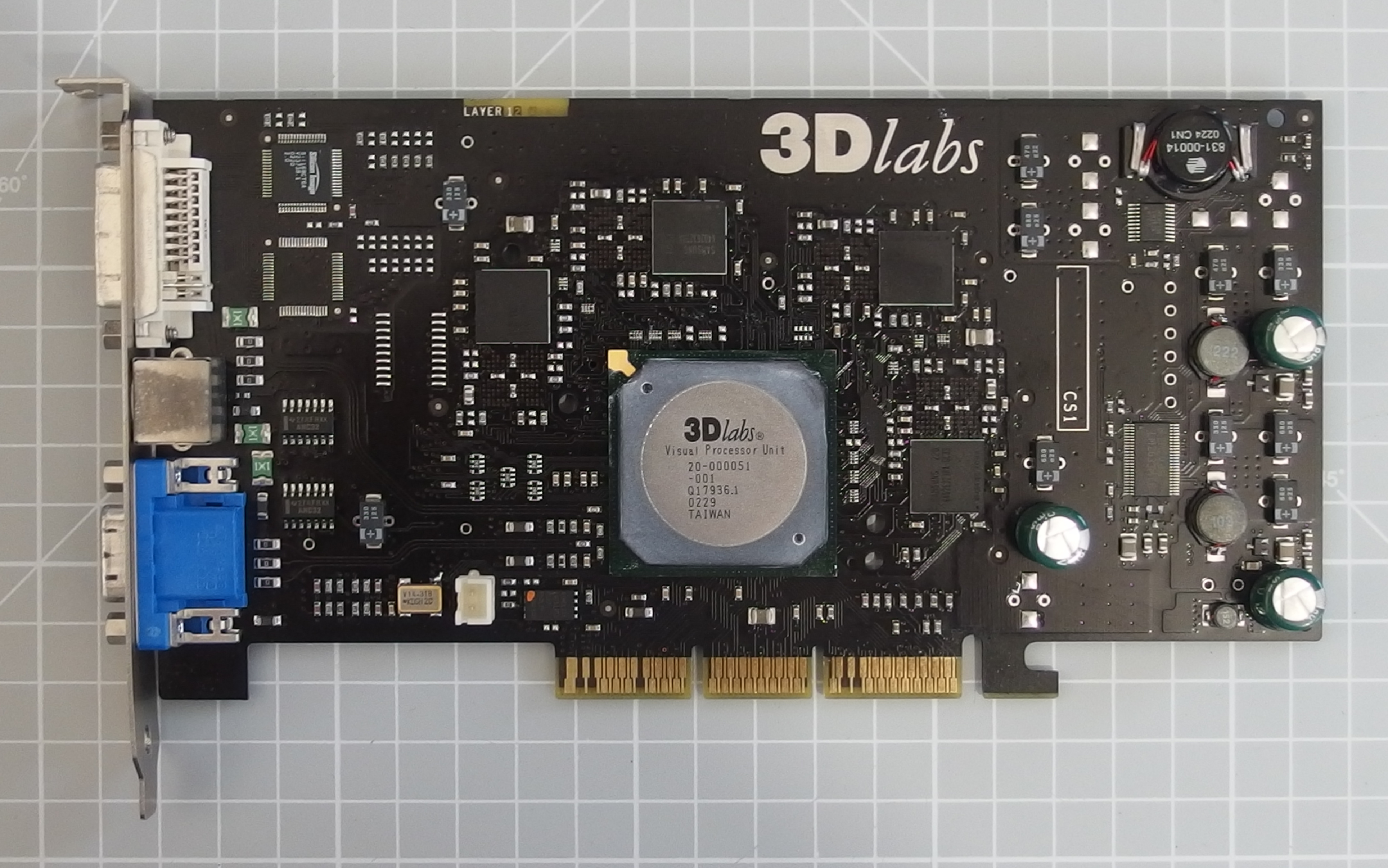
To feel why GLINT mattered, you have to remember what a graphics card was in 1994, because it was nothing like the slab in your machine today. Back then the work was scattered. Your main processor did the 3D maths. One card might accelerate 2D so your desktop felt responsive. A second card might accelerate 3D. The famous gaming cards that defined the decade often did 3D and nothing else, so you literally fitted a separate 2D card beside them just to run Windows. Three things, three bottlenecks, and a CPU sweating over geometry it was never built for.
GLINT did something no single chip had managed before. It took all the rendering, fragment processing and rasterisation steps of OpenGL, added full-speed Z-buffering, dithering and anti-aliasing, and ran the whole pipeline on one die. The application threw triangles at it through the OpenGL interface, and GLINT handled what happened next. It was, in the language of the time, the first fully integrated, OpenGL-compatible workstation graphics chip.
And the numbers were genuinely silly. GLINT carried around one million transistors and claimed two and a half billion operations a second. A typical PC graphics chip of the day got by on about fifty thousand transistors. So 3Dlabs did not nudge the bar. It moved it twenty times in a single jump.
When 3Dlabs formally launched in April 1994 and laid out the GLINT 300SX and 300TX, the industry was stunned. The thing Silicon Graphics charged tens of thousands of dollars to do could now be done with a graphics card costing a few hundred. The price gap was not a discount. It was a different order of magnitude. Compaq, Digital Equipment and Hewlett-Packard started fitting GLINT into their workstations. Board makers like Diamond and ELSA built cards around it. Even the multimedia firm Creative Labs, remember that name, shipped a product using it. A small company outside London had just walked into the most prestigious room in computing and undercut everyone in it. Now they wanted the biggest room of all, and that ambition would nearly be the making of them, and then the breaking.
06 / the billion-dollar climb
The billion-dollar climb
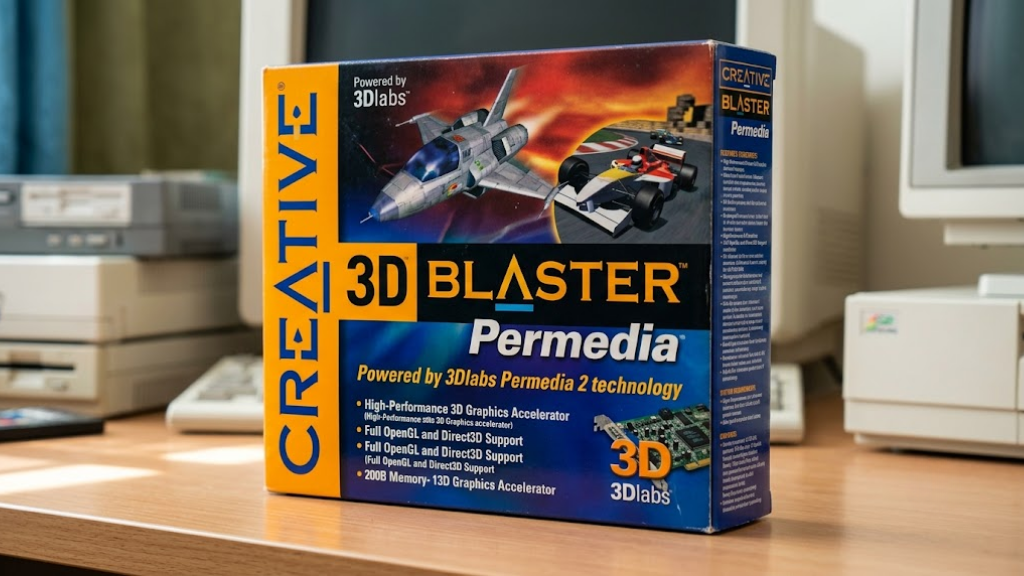
The workstation win was real, but workstations are a small, rich market. In 1995 Kent and Ahiska reached for the big one: ordinary consumers. The problem was that GLINT was built for professionals and priced for them, far above what a PC gamer would ever pay. The answer was a cut-down chip family called Permedia, GLINT's architecture brought down to the high street, with low-cost 2D and 3D acceleration and video playback rolled together. With Windows 95 and Windows NT taking off, those features were suddenly worth gold. Creative Labs was first in the queue, and its 3D Blaster put consumer 3D on shelves for Christmas 1995. By 1997, Permedia 2 had shipped over a million units and was sitting inside PCs from Acer, Compaq, Dell, IBM and NEC.
The money followed. 3Dlabs went public on NASDAQ in October 1996, and the cash gave it real firepower. Revenue tells the story better than any adjective: from $19.7 million in 1996 to $69.1 million in 1997, up two hundred and fifty per cent in a year. At the top of the late-nineties boom the company's market value approached a billion dollars. Two Turkish engineers who had started in a flat outside London now ran a billion-dollar player in Silicon Valley. And then, quietly, inside the company, the most important thing they ever did began to take shape.
GLINT was brilliant at turning triangles into pixels, but the geometry, the maths that decides where each triangle sits and how light falls on it, still lived on the CPU. That transform and lighting stage was the processor's most punishing job. In 1997, at the Comdex show in Las Vegas, 3Dlabs answered it with two new chips, code-named Gamma. These were the first commercial silicon to take geometry off the CPU and run it in hardware. In effect, 3Dlabs had built the world's first programmable transform and lighting engine. Architects who had watched a building model freeze every time they rotated it, car designers who waited minutes to see light move across a panel, suddenly got their answer in under a second.
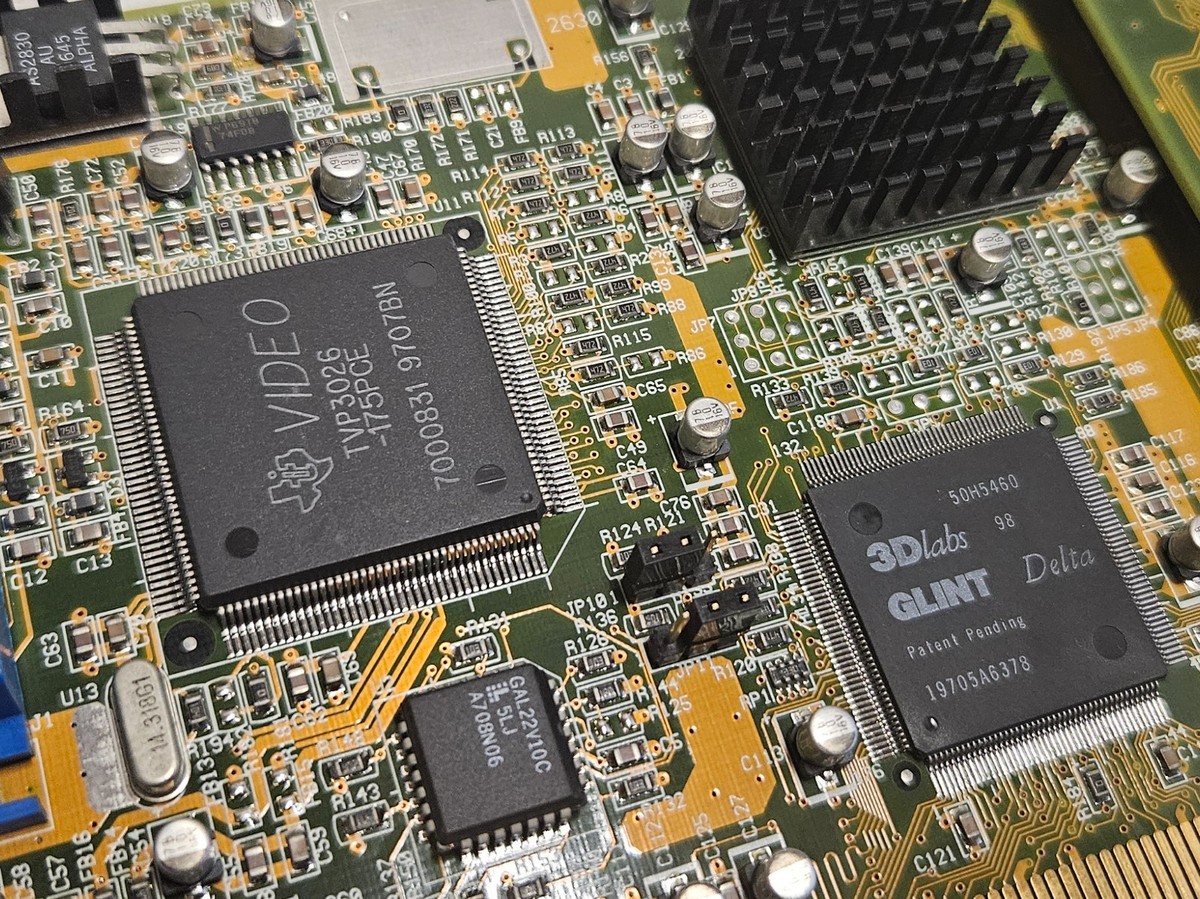
And here is the detail that the whole story turns on. To describe what this chip was, 3Dlabs reached for a word that had no settled meaning yet. They called it a GPU. In their hands it stood for geometry processor unit, and in their design it was a separate chip, named Delta, working alongside the GLINT rasteriser. It was a multi-chip solution, and it was, by some distance, ahead of its time. The word went into their materials. Then, in 1999, somebody else picked it up and made it immortal.
| Who | When | What they called it | What it really was |
|---|---|---|---|
| Sony (PlayStation) | 1994 | GPU | A geometry transformation engine, simpler than a modern GPU |
| 3Dlabs (GLINT) | 1994 | Graphics processor | First fully integrated single-chip OpenGL 2D and 3D part |
| 3Dlabs (Gamma) | 1997 | GPU (geometry processor unit) | First commercial hardware transform and lighting, multi-chip |
| NVIDIA (GeForce 256) | 1999 | GPU (graphics processing unit) | First fully integrated single-chip GPU with on-die T&L |
| ATI (Radeon 9700) | 2002 | VPU | The term that lost the marketing war |
Look at that table for a moment, because it is the crux of everything. NVIDIA did something genuinely new with the GeForce 256: it folded transform, lighting, triangle setup and rendering into a single chip and marketed it, brilliantly, as the world's first GPU. That single-chip integration was a real milestone, and NVIDIA earned the cheering. But the idea that graphics deserved its own dedicated processor, and even the three letters used to name it, had been articulated years earlier by a company most people have never heard of.
It gets sharper still. In May 1999, months before the GeForce 256, 3Dlabs shipped the Oxygen GVX1, a workstation card that already did transform and lighting in hardware using a separate geometry chip. The hardware T&L that NVIDIA would soon present as a revolution was, in 3Dlabs' world, already running. The difference, and it was the difference that decided history, was that NVIDIA put it all on one piece of silicon, aimed it at millions of gamers, and told a story the whole world could repeat. 3Dlabs had the firsts. NVIDIA had the narrative. Guess which one the history books wrote down.
07 / the offers they turned down
The offers they turned down
By the turn of the millennium, 3Dlabs was a serious power. It had bought rivals to deepen its bench, picking up Dynamic Pictures in 1998 and the Intense3D division of Intergraph in 2000 for around fifty-five million dollars. It held close to three hundred patents. Its professional cards, sold under the Wildcat and Oxygen names, were becoming standard in the workstations that ran the world's engineering, car design and film effects work. And it was at exactly this peak that one of the strangest sets of refusals in technology history played out.
By the founders' own account, the offers came in and they said no. One of them, the story goes, came from Steve Jobs. Pixar was rebuilding its graphics infrastructure, it had defined the standard for 3D animation with its RenderMan software since the eighties, and on the hardware side it needed ever stronger, more efficient chips. Talks began. Kent and Ahiska turned the approach down. They were not alone on the list of suitors. NVIDIA, by their telling, also sat across the table. A company of three hundred patents, a cornerstone of the professional graphics world, kept handing back the cheques.
The refusals meant two things at once. The founders believed they could carry the company further on their own. And the optimism at the very top of a technology bubble was hiding exactly how real the risks were. Both turned out to be true.
This is the moment in any LOST-shaped story where you want to shout at the screen. Take the deal. Cash out. You were right about everything, you saw the future before anyone, just take the money while the market still believes. But of course they could not hear you, because from inside 1999 it did not look like a peak. It looked like a beginning. They had a chip in the lab that they believed would humble everything else on earth, and they were about to bet the company on it. Its name was P10, and on the horizon behind it was a storm with a very specific name. The dot-com crash.
08 / P10, the crash, and the fall
P10, the crash, and the fall
In 2001 they revealed the most audacious thing they had ever built. It was called P10, and it threw out the old idea of fixed graphics circuits entirely. The chip ran more than two hundred small processors in parallel across the geometry, texture and pixel stages, and the headline number was almost rude: a claimed one trillion operations per second, a full teraflop, on a single piece of silicon. The whole industry stopped and stared. This was not workstation news, this was everyone's news, and even NVIDIA had not put a number like that on a consumer part. P10 was built to tear the ceiling off professional graphics. And then, on the horizon, the storm that every technology company feared finally made landfall.
It had a name everyone now knows: the dot-com crash. From March 2000 the NASDAQ had been falling, and within a year half the value of the technology index had simply evaporated. Silicon Valley filled with layoffs, folded venture funds and shattered valuations, and 3Dlabs took the wave full in the chest. Its share price slid, order forecasts dropped, and the big customers froze their budgets overnight. Worse, the competition picked exactly this moment to come for the one market 3Dlabs owned.
ATI folded the FireGL brand into its line-up and aimed it straight at the professional segment 3Dlabs had spent years building. NVIDIA, with its Quadro brand, set about surrounding that same market with method and patience. Both could subsidise professional cards from the enormous scale of their consumer business. 3Dlabs had no such cushion.
The cruelty of the timing is hard to overstate. P10 shipped late. The Wildcat 3 cards built around it finally reached shelves at the start of 2002, but by then the market was different, the rivals were different, the budgets were different. The most advanced architecture in professional graphics had arrived into a room that had stopped clapping. And for the first time in its life, the company that had been early to everything began, quietly, to lose money. The offers came back to the table. This time, nobody was going to say no.
09 / the legacy hidden in the code
The legacy hidden in the code
In June 2002, Creative Technology, the Singapore-based audio and multimedia firm that had been a 3Dlabs partner for years, bought the company for around a hundred million dollars in cash and shares. Sit with that sentence. A company two Turkish engineers had founded in a corner of London, sold to DuPont, bought back, floated on NASDAQ and grown to nearly a billion in value was now a wholly owned subsidiary of a sound-card maker. When Osman Kent walked out of the building, what he left behind was not just a company. It was close to three hundred patents, a foundational contribution to OpenGL, and the engineering documents where the word GPU had first been written down. All of it now sat in someone else's vault.
The team scattered. Some engineers went to NVIDIA, some to Intel, the people who had built graphics history dispersing across the very giants who would write the next chapter. But the ones who stayed knew they had one piece of unfinished business left, and it was important enough to rewrite the future of all computer graphics. That work was OpenGL 2.0.
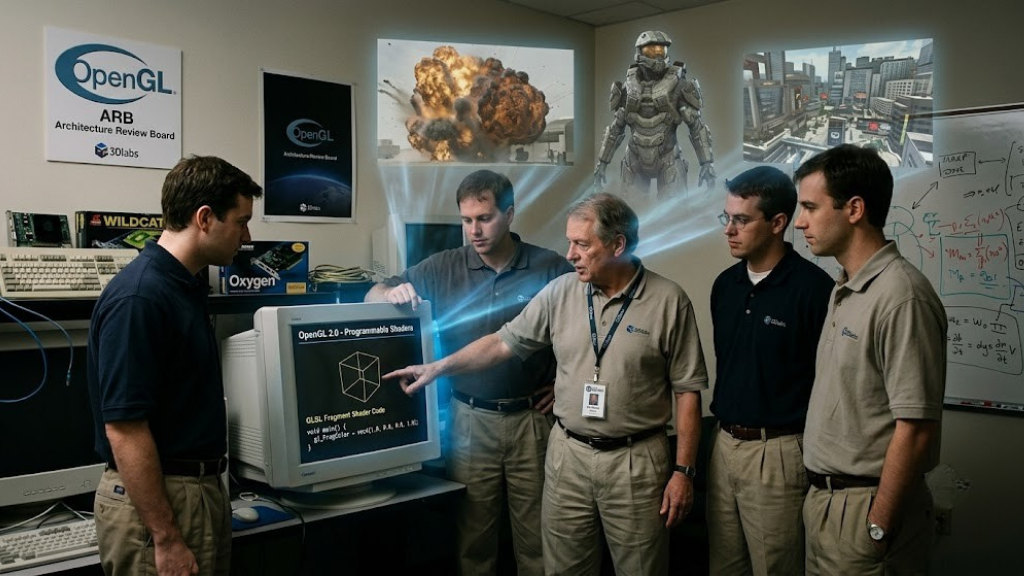
To see why it mattered, step back. Since 1992, OpenGL had been the common language of graphics, the way architects, film engineers and flight-simulator developers all spoke to the hardware. But the language had a problem. It was rigid. It offered a fixed pipeline: developers could only walk the paths OpenGL already laid out, with predetermined rules for how light behaved, how shadows were computed, how pixels took their colour. Stepping outside those rules was impossible, and 3Dlabs had spent years wrestling that wall. Its professional users wanted something more flexible, something programmable, and the committee that governed the standard kept choosing to protect what already existed.
So 3Dlabs put a radical idea in front of that committee: loosen the fixed pipeline, and let developers write their own programs that run directly on the GPU. Turn the graphics chip from a thing that only draws into a programmable engine. They called the proposal the OpenGL Shading Language, or GLSL. There was resistance, because standards move slowly and committees like the brakes, but the idea pointed so clearly in the right direction that the argument eventually opened a door that could not be closed again. GLSL became one of the core pieces of OpenGL 2.0 in 2004.
Every modern shader, every programmable effect in every game and film, descends from the idea that you can write code that runs on the graphics processor. 3Dlabs did not invent all of it alone, but it pushed the door open. CUDA, shader models, the entire world of GPU computing that now trains AI all stand on the far side of that threshold. The company was dying, and on the way out it helped write the rule that made the next thirty years possible.
That is the part almost nobody tells you. The firms that hire the engineers get the headlines. The standard everyone builds on becomes invisible the moment it is adopted. So the deepest mark 3Dlabs left on computing is also the one you can least see, buried in the code running on the very chip you are reading this on. But the founders themselves were not finished. One of them was about to do something that nobody who knew him as a chip executive could have predicted, and the company's old patents were about to come back to life in a courtroom.
10 / a record label and a lawsuit
A record label and a lawsuit
Here is where the story stops behaving like a technology story at all. To understand what Osman Kent did next, you have to go all the way back to a boy in Ankara who wanted to be a musician, who taught himself piano, who was playing his own compositions at fourteen and dreamed of the Royal Academy of Music in London before his family steered him, sensibly, into electronics. He never stopped being that boy. He just used engineering, then business, then a recording studio as his instruments, one after another.
When the towers fell in New York in September 2001, Kent, like a great many people, did a quiet accounting of his life. By his own telling, he decided life was short and the music he had filed away for decades had waited long enough. In 2002, the same year Creative was buying his company, he founded Songphonic Records with two million dollars, a label built to back young, undiscovered artists. Its first major project was an album with the South African singer Sanda Hoff, and when it was finished, nine of its eleven songs carried Osman Kent's name as writer or composer. The technology millionaire had become a music producer. The pivot looks absurd until you remember his graduation project in Birmingham was a machine that turned keystrokes into musical notation. He had been heading here the entire time.
Yavuz Ahiska took the quieter road, staying in technology, consulting, keeping his hand in research and development, the steady figure who never needed the stage. But the company they built kept generating one last surprise, and it is the most LOST-shaped twist of all. Remember the patents. Remember that 3Dlabs had spent the late nineties thinking about how to push graphics across distances, how to send rendered images from a powerful machine to a weaker one. Years later, entities connected to the founders held patents describing exactly that: streaming interactive graphics from a server to a remote device. In 2019, one of them took those patents into a United States court and sued Sony, arguing that modern cloud gaming, the streaming of PlayStation games to far-away screens, ran on ideas they had patented when the PlayStation was still young.
Read that again. In the late 1990s, two engineers patented the idea of streaming a game from a distant server to a screen in your hands. Two decades later, the whole industry calls it cloud gaming and treats it as new. 3Dlabs was early to the single-chip graphics processor. Early to hardware geometry. Early to the word GPU. Early to programmable shaders. And early, it turns out, to the cloud. Early to almost everything, and credited for almost none of it.
The corporate name itself faded out along the way. After Creative wound down the professional graphics line in 2006, the remaining business was rebranded and moved to Singapore as ZiiLABS in 2009, building low-power media processors for phones and tablets around ARM cores and an array it called the Stemcell Computing Array. The badge that said 3Dlabs passed into history. But a name disappearing is not the same as a story ending, and there was still one question this whole article had been circling. It is time to answer it honestly.
11 / so who built the first GPU?
So who really built the first GPU?

Let us be honest rather than romantic, because the honest answer is more interesting than a clean one. If you define a GPU strictly, the way the industry settled on defining it, as a single chip that does geometry, lighting, triangle setup and rendering all together, then NVIDIA's GeForce 256 in 1999 has the cleanest claim. It put the whole pipeline on one die, aimed it at millions of people, and told a story the world could repeat. That was a genuine engineering milestone, and NVIDIA earned the place it holds in the history books.
But milestones have foundations, and 3Dlabs poured a remarkable number of them. GLINT, in 1994, was the first fully integrated single-chip OpenGL graphics part, doing 2D and 3D and full-speed Z-buffering on one piece of silicon while ordinary chips had a fraction of its transistors. The Gamma chips, in 1997, were the first commercial hardware to take transform and lighting off the CPU. And the word GPU, the three letters now printed on the side of every graphics card on earth, was being used in 3Dlabs materials before NVIDIA made it immortal. The graphics historian Jon Peddie put the whole tangle perfectly when he said you can "slice and dice history as you like". There is no single inventor of the GPU. There is a chain of firsts, and a Turkish company outside London holds more links in that chain than almost anyone remembers.
3Dlabs had the firsts. NVIDIA had the narrative. And in technology, as in most things, the narrative is what survives. The lesson is not that history is wrong. It is that being first and being remembered are two completely different achievements, and 3Dlabs collected the first while almost entirely missing the second.
That is the real shape of this story, and it rhymes with others on this site. The Amiga was years ahead of the machines that buried it. 3dfx defined what a gaming graphics card should feel like and then vanished into the company it had taught. 3Dlabs belongs in that strange, brilliant company of pioneers who arrived early, lit the path, and watched someone else walk down it to the prize. Two engineers met by chance in England, built the first real graphics processor, used the word before the world did, shaped OpenGL, helped invent programmable shaders, and may even have patented the cloud. They changed the thing you are looking at right now. They just never stood on a stage to say so. Pour the last of that coffee. Look at any screen you own, any graphics engine you run, any game you load. The mark those two engineers left is still there, quietly, in all of it. You simply had to be told where to look.
FAQ / questions, answered
Questions, answered
Who founded 3Dlabs?
3Dlabs was founded in April 1994 by two Turkish engineers, Osman Kent and Yavuz Ahiska, through a management buyout of DuPont Pixel Systems. The pair had started out in London in 1983 with a company called benchMark Technology, which DuPont bought in 1988 before they reclaimed the graphics business and renamed it 3Dlabs.
Did 3Dlabs really make the first GPU?
It depends on the definition, and that is exactly the point. 3Dlabs has a strong claim to several firsts: its GLINT 300SX (1994) was the first fully integrated, OpenGL-compatible single-chip graphics processor, and its 1997 Gamma chip was the first commercial hardware transform and lighting engine. 3Dlabs also used the term "GPU" before NVIDIA. NVIDIA, however, built the first fully integrated single-chip GPU with on-die transform and lighting, and popularised the name, with the GeForce 256 in 1999.
What was GLINT?
GLINT was 3Dlabs' first graphics chip, launched in 1994. It put OpenGL rendering, rasterisation, shading and full-speed Z-buffering on a single piece of silicon, with around one million transistors, at a time when a typical PC graphics chip had roughly fifty thousand. It brought workstation-class 3D to machines costing a fraction of a Silicon Graphics workstation, and OEMs including Compaq, Digital Equipment and Hewlett-Packard built it into their systems.
What happened to 3Dlabs?
After peaking near a billion dollars in market value during the late-1990s boom, 3Dlabs was squeezed by ATI and NVIDIA, then hit hard by the dot-com crash. Creative Technology bought it in 2002 for around a hundred million dollars. The professional graphics business was wound down in 2006, and the company was rebranded as the Singapore-based ZiiLABS in 2009. Its engineers went on to NVIDIA and Intel, and its patents and its work on OpenGL still run through the industry today.
// end
more / keep reading
3dfx and the Voodoo that taught the world to game
The company that defined the gaming graphics card, then vanished into the rival it had trained.
AnalysisNVIDIA is not a GPU company any more
How the firm that won the word GPU quietly became something much larger than graphics.
RetroThe Amiga 500, a machine years ahead of its time
Another pioneer that saw the future early and was buried by the machines that copied it.