
// the silicon chokepoint
One Company Controls Every Advanced Chip on Earth. Can China Break It?
How a leaking shed in the Netherlands became the most contested machine on the planet, and why your next GPU, your phone, and the global balance of power all run through a town you have never heard of.
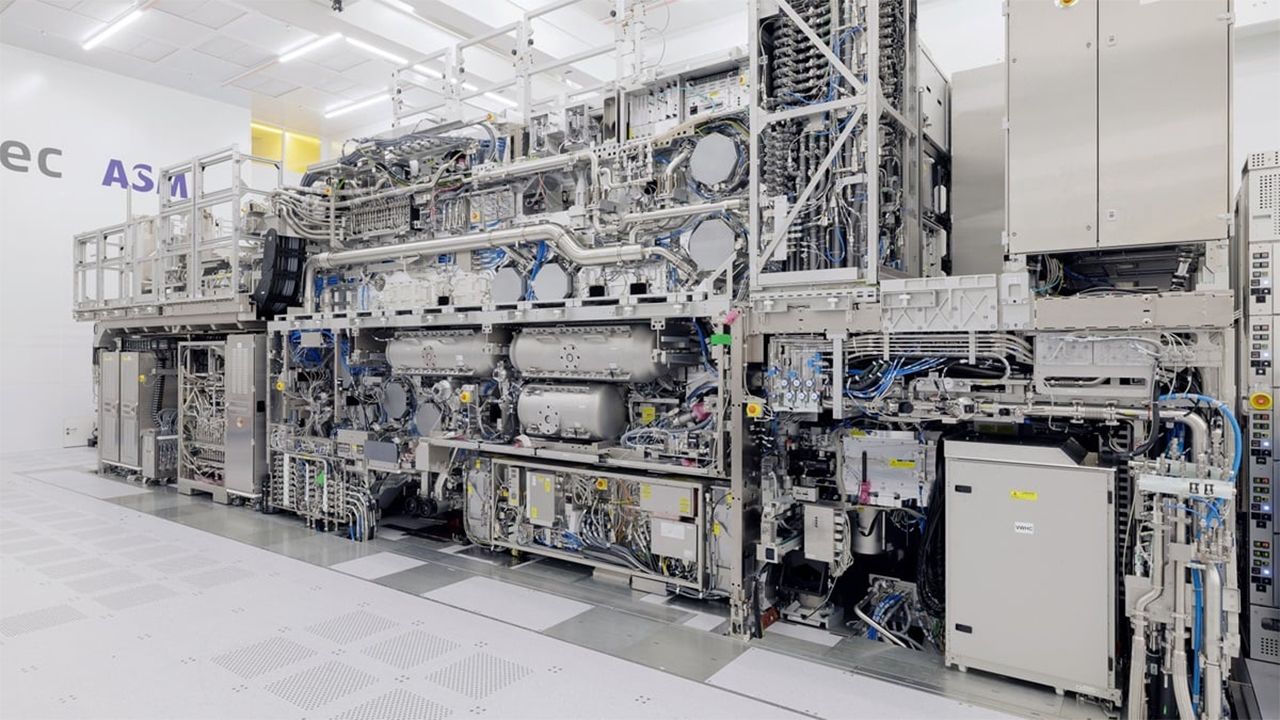
Which machine is so important that nations rise and fall on who is allowed to buy it? Why does every chip in your pocket, your car, and the world's most advanced weapons trace back to one quiet Dutch town? How does a single company keep zero competitors for twenty years, on purpose? And what exactly breaks, for NVIDIA, for Apple, for your next phone, the day China finally builds its own?
The answers all point to the same place, and almost nobody can name it.
01 / the town where the world holds its breath
The town where the world holds its breath
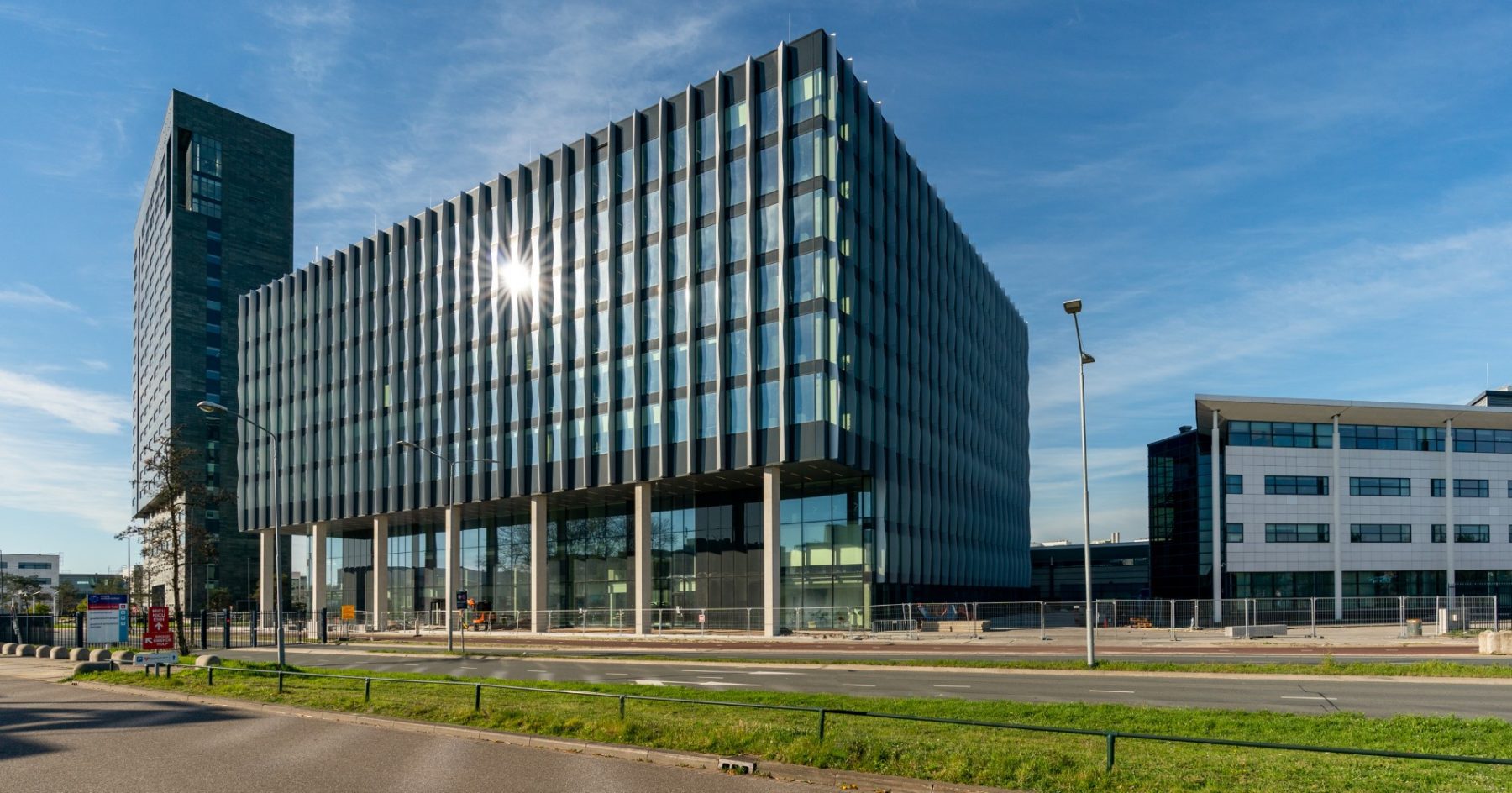
Veldhoven is the kind of place you would drive straight through without noticing. Low Dutch skies, tidy roundabouts, a population that would fit inside a single football crowd. And yet the most powerful governments on the planet lose sleep over what happens behind one fenced campus on its edge.
Because every company that makes the world's most advanced chips, Apple, NVIDIA, AMD, Samsung, Intel, all of them, can buy the one machine they cannot live without from exactly one supplier. That supplier is ASML, and it sits here. Not as the market leader. The market leader can be caught. This is something rarer and far more unnerving: a monopoly that the richest companies and the most ambitious states on Earth have spent years and tens of billions trying to break, and have not.
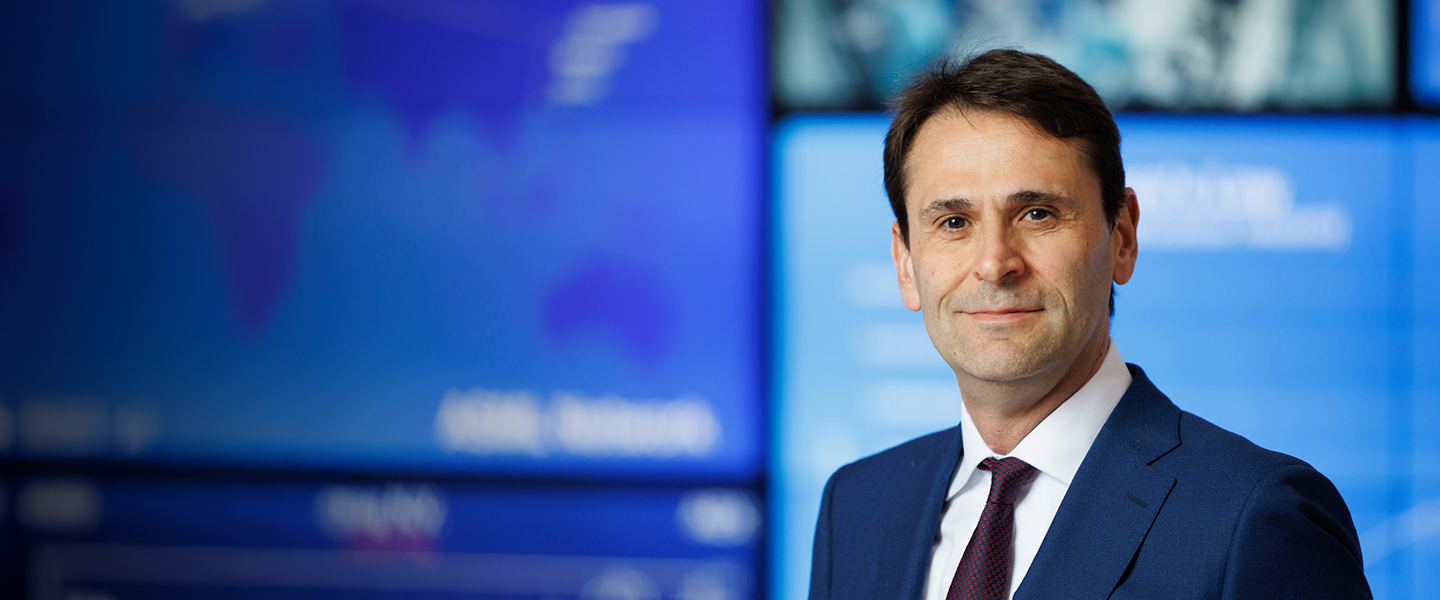
The machine prints chips. More precisely, it uses light to carve patterns onto silicon that are tens of thousands of times finer than a human hair, the patterns that become the billions of transistors inside the thing you are reading this on. The newest generation, extreme ultraviolet lithography, or EUV, is the only way to make the most powerful chips that exist. And in 2026 the picture is blunt. ASML's chief executive, Christophe Fouquet, was asked point blank about rivals and answered, "no one is coming for us." The company is now worth more than 530 billion dollars, the most valuable in Europe, on the strength of a single sentence: when you use AI, somewhere down the chain, you are depending on them.
02 / from a leaking shed to the center of the world
From a leaking shed to the center of the world
It began, as the best industrial legends do, in a place nobody would have bet a euro on. The year was 1984. The setting was not a gleaming headquarters but a wooden cabin pressed up against the Philips campus, with a roof that, by company lore, leaked when it rained.
ASML, then Advanced Semiconductor Materials Lithography, was born as a joint venture between Philips and a small Dutch equipment maker called ASM International. On paper it promised potential. In reality it was Philips quietly pushing a technology it no longer found profitable out of the door, spreading the risk. The American and Japanese giants of the day, Nikon and Canon, ran the lithography market with an iron grip. A handful of engineers in a damp shed, with a thin budget and a stubborn idea, were not supposed to matter.
The idea was a contrarian one. The machines of the era, called steppers, held the silicon wafer still and moved the lens. ASML's engineers did the opposite: they pinned the lens in place and moved the wafer beneath it, at high speed and with absurd precision. It sounds like a footnote. It was the first crack of daylight, the move that bought them both speed and accuracy their rivals could not match.
Engineering brilliance does not pay salaries, though, and for years it nearly killed them. The company bled money. In the early 1990s Philips began pulling back its stake. ASML stood at the edge of bankruptcy. And then, from the other side of the world, a young foundry that almost nobody yet feared placed a bet on the Dutch outsider. Taiwan Semiconductor Manufacturing Company, TSMC, saw what ASML's machines could become and trusted them. It was the start of a partnership that would remake both companies, and eventually the world.
FIG. 1 / ASML, FROM NEAR-DEATH TO MONOPOLY (1984 to 2026)
03 / the impossible bet nobody else would take
The impossible bet nobody else would take
By the late 1990s, the entire chip industry was chasing a dream it could not reach. To keep Moore's law alive, that famous promise of doubling transistors every couple of years, chipmakers needed to draw ever finer lines. And to draw finer lines, you need light with a shorter wavelength.
Here is the cruel joke physics played on them. Push the wavelength short enough and you arrive at extreme ultraviolet, light so energetic that it simply refuses to behave. It does not pass through glass. It does not pass through air. It is swallowed by almost everything it touches, including, infuriatingly, ordinary mirrors. In theory EUV was elegant: a sharper pencil for a finer drawing. In practice it was closer to impossible.
Nikon and Canon, the very giants that had ruled the market for decades, looked hard at the cost and the physics and made a rational decision. They called it madness and walked away. ASML did the opposite. It stayed in the room, alone, and committed to a journey that would swallow roughly twenty years and tens of billions of dollars with no guarantee at the end of it.
To tame EUV, ASML had to manufacture the smoothest surfaces humanity has ever made, build a flawless vacuum inside a machine the size of a bus, and create a new kind of light from scratch.
It is worth sitting with how reckless that looked at the time. A company that had nearly gone bankrupt was now betting its future on a technology its bigger, richer rivals had judged unbuildable. That is not a strategy a quarterly-earnings culture produces. It is the kind of bet you only make when you are willing to be wrong for two decades.
04 / three miracles inside one machine
Three miracles inside one machine
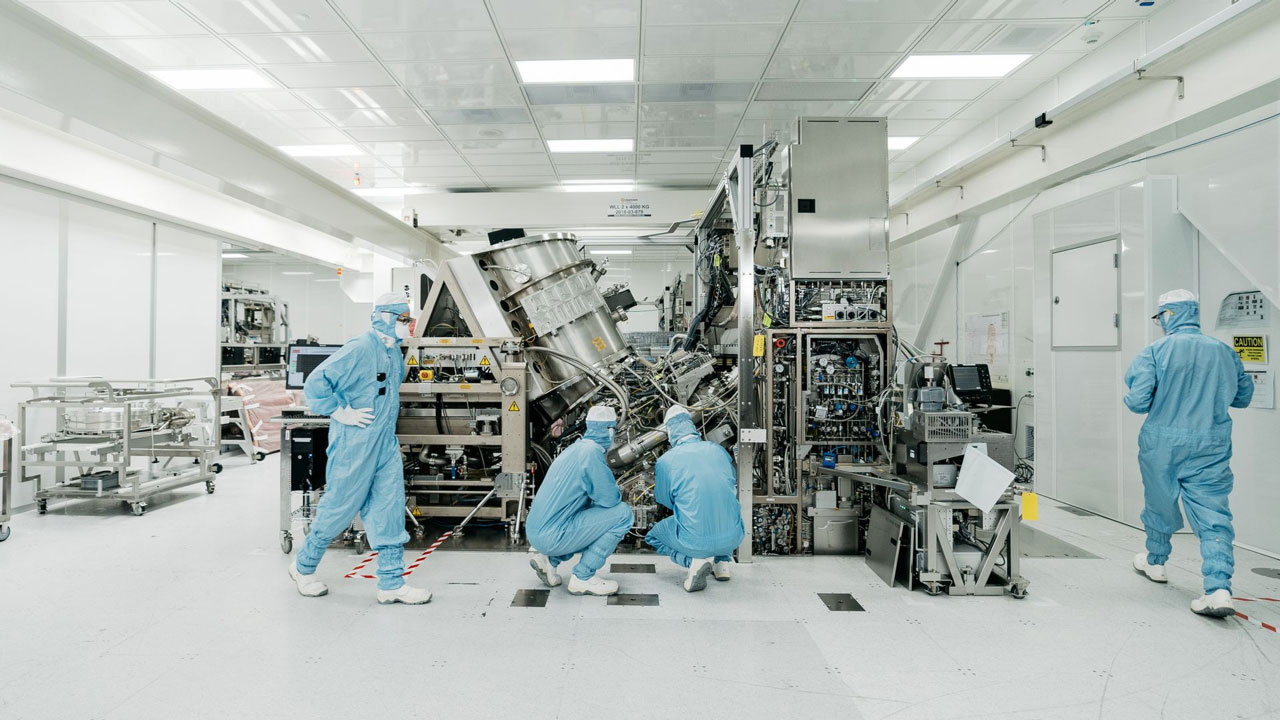
What ASML eventually built is less a fabrication tool than a piece of working science fiction. Strip away the marketing and an EUV machine rests on three separate miracles, any one of which would be a landmark on its own.
Miracle one: make the light
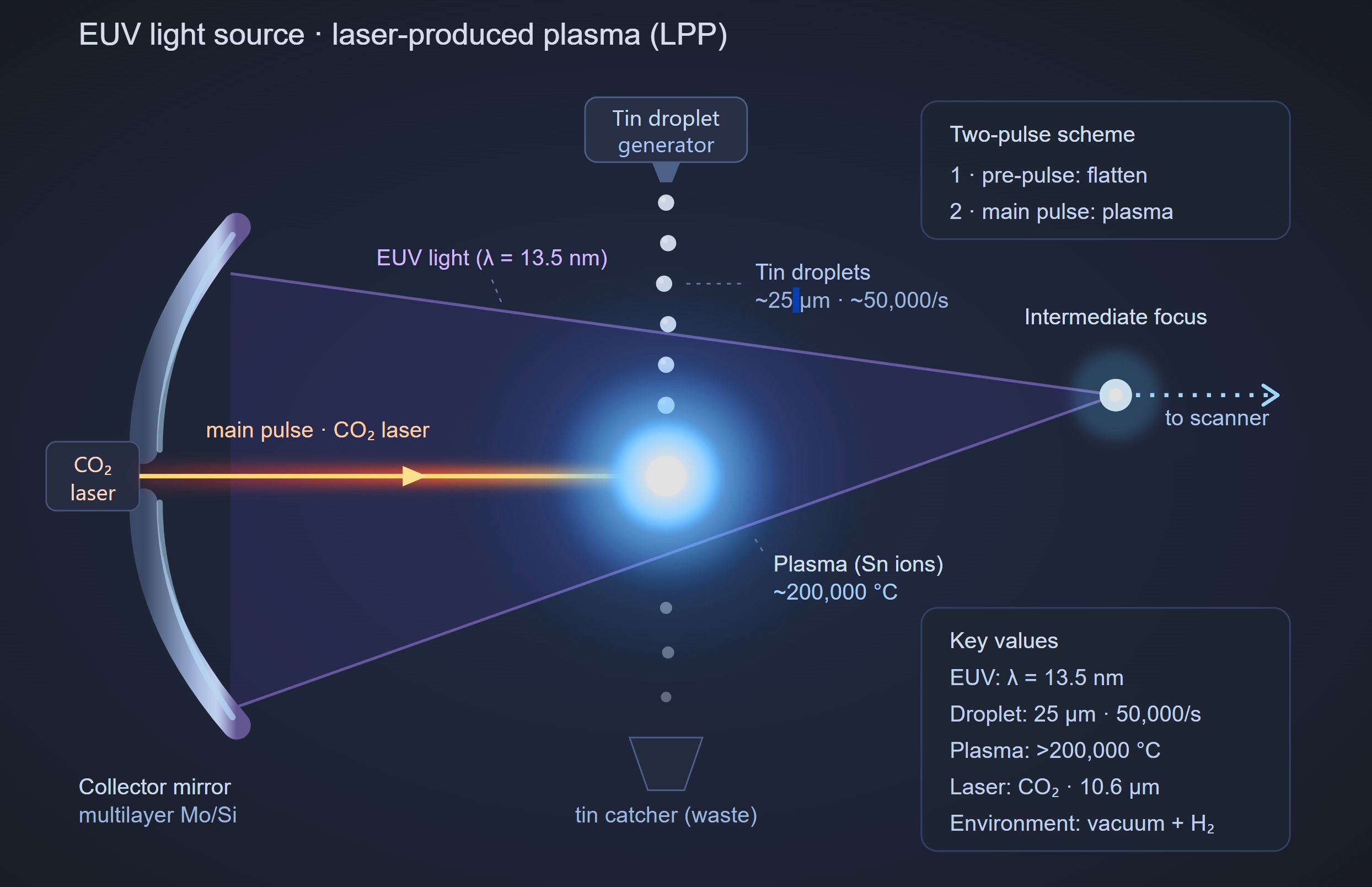
Fifty thousand times every second, a droplet of molten tin smaller than a grain of sand is fired across a vacuum chamber. As each droplet reaches its mark, a powerful carbon-dioxide laser strikes it not once but twice. The first pulse flattens the droplet into a pancake. The second, far more violent, vaporises it into a plasma hotter than the surface of the sun. In that instant, for a sliver of a second, the light they spent twenty years chasing exists at last, a pure flash of EUV.
Miracle two: steer the light
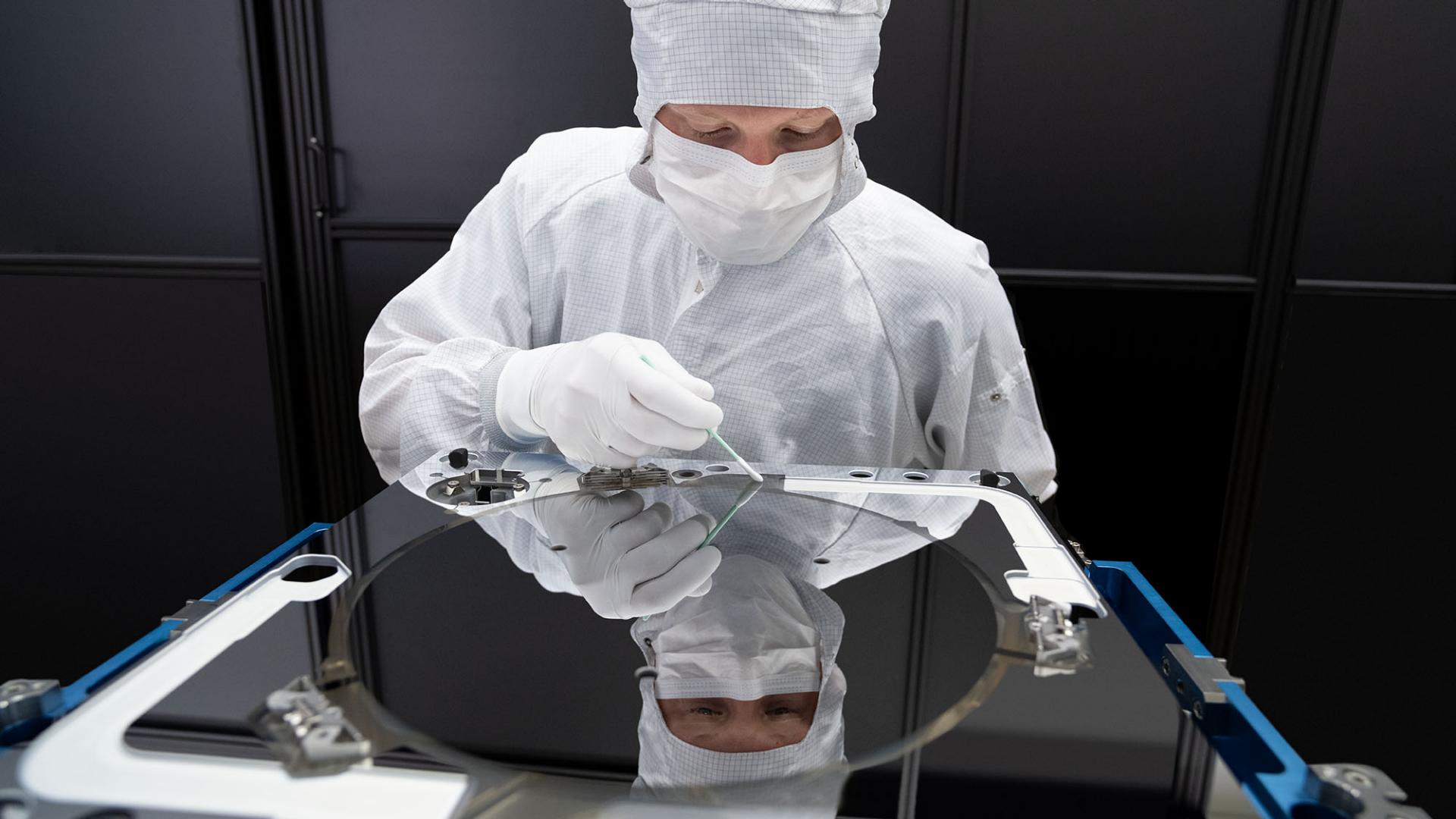
Now they have to aim it, and they cannot. EUV burns straight through air and glass, so every conventional lens is useless. The only option is mirrors, and not the kind you own. These are made by the German optics house Carl Zeiss, and they are the smoothest surfaces ever manufactured by human beings. The light ricochets through a labyrinth of these flawless mirrors, losing energy at every bounce, all inside a perfect vacuum so that not a single molecule of air can steal it before it lands on the wafer.
Miracle three: move the wafer
Finally, the silicon itself has to move. The platform it sits on accelerates harder than a fighter jet pulling out of a dive, then stops dead at each position with an error smaller than the width of a strand of DNA. It does this thousands of times over, floating on magnets, never quite touching the rails it rides. Hundreds of thousands of parts, kilometres of cabling, tens of thousands of sensors, and some of the most complex software on the planet, all conspiring toward one goal: perfect patterns at the scale of atoms.
FIG. 2 / ANATOMY OF AN EUV MACHINE, THE THREE MIRACLES
05 / the day the industry split in two
The day the industry split in two
In 2017, after years of quiet and costly work, ASML's first commercial EUV machine left the lab and rolled onto TSMC's production line. TSMC had wagered everything on a technology that was still unproven, taking a historic risk in front of its rivals. It became one of the most profitable moves in the history of technology.
With EUV, TSMC could print the 7nm and then 5nm nodes that competitors were struggling to reach through slower, error-prone, multi-step workarounds, and it could do it in a single elegant pass. The effect on the industry was seismic. The companies that adopted these machines first sprinted ahead. The ones that hesitated were left behind, and one hesitation in particular still echoes.
Intel blinked. The company that had set the pace of the entire industry for forty years looked at EUV, weighed the cost and the risk, and waited. It is arguably the most expensive hesitation in modern technology. While TSMC churned out faster, denser, more efficient chips for the world's biggest customers, Apple chief among them, Intel slipped behind in manufacturing for the first time in living memory. Samsung, refusing to be locked out, rushed in with billions of dollars in EUV orders. The rule had become brutally simple.
Either you own an ASML EUV machine, or you fall out of the top tier of chipmaking. The whole market had quietly reorganised itself around a machine from Veldhoven.
| Chipmaker | The EUV bet | What it cost them, or won them |
|---|---|---|
| TSMC | All in, first to deploy in 2017 | Leapt to 7nm then 5nm; won Apple, NVIDIA, AMD; became the most important foundry on Earth |
| Intel | Hesitated, adopted late | Lost its manufacturing lead for the first time in decades |
| Samsung | Scrambled to catch up | Forced into billions in EUV orders just to stay in the race |
06 / why your GPU lives or dies in Veldhoven
Why your GPU lives or dies in Veldhoven
Here is the part that should make every gamer, every AI startup, and every data-center buyer pay attention. Strip away the logos and a Blackwell, a Vera Rubin, or an AMD Instinct GPU is, at bottom, a pattern. An unimaginably fine pattern. And there is exactly one kind of machine on Earth that can print it.
NVIDIA does not own a single fab. Neither does AMD. Their most advanced chips are manufactured by TSMC, and TSMC's leading-edge nodes are printed on ASML EUV machines. Follow the chain and it narrows to a single point of failure. This is the same logic we followed when we argued that NVIDIA is no longer really a GPU company at all, and it sits underneath the entire bet behind the rack-scale Vera Rubin systems NVIDIA is staking its future on. Even the card on your desk, the one we put through its paces in our RTX 5090 review, started life as light bent through Dutch and German optics.
The chokepoint is even longer than ASML alone. The raw silicon wafers come overwhelmingly from two Japanese firms, Shin-Etsu and SUMCO. The advanced packaging that binds GPU and memory together, TSMC's CoWoS, is its own bottleneck. The high-bandwidth memory stacks are a third. But of all these pinch points, EUV is the most absolute, because it is the one with a single supplier and no plan B.
And it is not abstract. In early 2026, with export rules choking its China sales, NVIDIA halted production of its H200 chips for that market and shifted that precious TSMC capacity toward Vera Rubin instead. TSMC is racing to diversify, new lines in Taiwan, a second fab in Arizona, another in Japan, but every one of those fabs, wherever it stands, still needs an EUV machine from one Dutch company. Geography can move. The dependency cannot.
FIG. 3 / THE CHOKEPOINT: HOW SAND BECOMES YOUR GPU
07 / the heist
The heist
A secret is worth precisely as much as the number of people willing to steal it, and by the late 2010s ASML's EUV know-how had become the most coveted industrial secret on the planet. The first real breach of the fortress came not from outside, but from within.
In 2019 the respected Dutch newspaper Het Financieele Dagblad ran a story that rattled the technology world. At its center was a Silicon Valley company called XTAL, founded in 2014 by a former ASML engineer named Zongchang Yu. According to court records, a group of former employees walked out of ASML's American software subsidiary, Brion, carrying a fortune with them. One engineer was accused of taking all two million lines of source code for critical lithography software, then sharing it. Within a year XTAL was poaching ASML's own customers, Samsung among them.
A Santa Clara jury was unconvinced by the defense. The final 2019 judgment ordered XTAL to pay ASML a staggering 845 million dollars for stealing trade secrets and luring away employees. The company promptly filed for bankruptcy, and ASML called the sum effectively uncollectable. What turned a corporate-theft case into a geopolitical alarm bell was the reporting that XTAL's parent, the Beijing-based Dongfang Jingyuan, had ties to China's Ministry of Science and Technology, and had taken state subsidies aimed at strengthening China's grip on chip machinery.
Whatever the motive, the effect was the same. The invisible chokepoint had been made visible, and Western governments now had a concrete reason, not a hypothetical one, to treat ASML's technology as something to be guarded by the state.
08 / how a machine became a weapon
How a machine became a weapon
Once you realise that whoever controls the most advanced chips controls the future of artificial intelligence, of advanced weapons, of communications, the machine that makes those chips stops being industrial equipment and starts being a strategic asset. That realisation arrived in capital cities with force.
It started in 2019, when, under pressure from Washington, the Dutch government blocked ASML from selling its most advanced EUV machines to China. In October 2022 the Biden administration went much further, announcing sweeping export controls designed to choke off China's access to advanced chips and the tools that make them. Those rules bound American firms directly, but the plan only worked if key allies joined. Japan and, above all, the Netherlands held the missing pieces. After months of intense diplomacy, by early 2023 the three governments had aligned, and the Dutch tightened the rules to restrict not only the newest EUV systems but some of the previous-generation DUV machines too.
For ASML this was a bitter prescription. The company has always seen itself as a maker of technology, not an arms dealer, and its leadership, then under chief executive Peter Wennink, warned repeatedly that controls could slow long-term innovation and fracture global supply chains. China was one of its largest markets. Shutting that door meant billions in lost revenue. But the decision had been made, and ASML had become, in effect, a geopolitical actor, expected to serve the strategic interests of a Western alliance as much as its own shareholders.
09 / can china build its own?
Can China build its own?
This is the question the whole story has been building toward, and it is the one most likely to be answered with hype in either direction. So let us be careful, because the truth is more interesting than the headlines on either side.
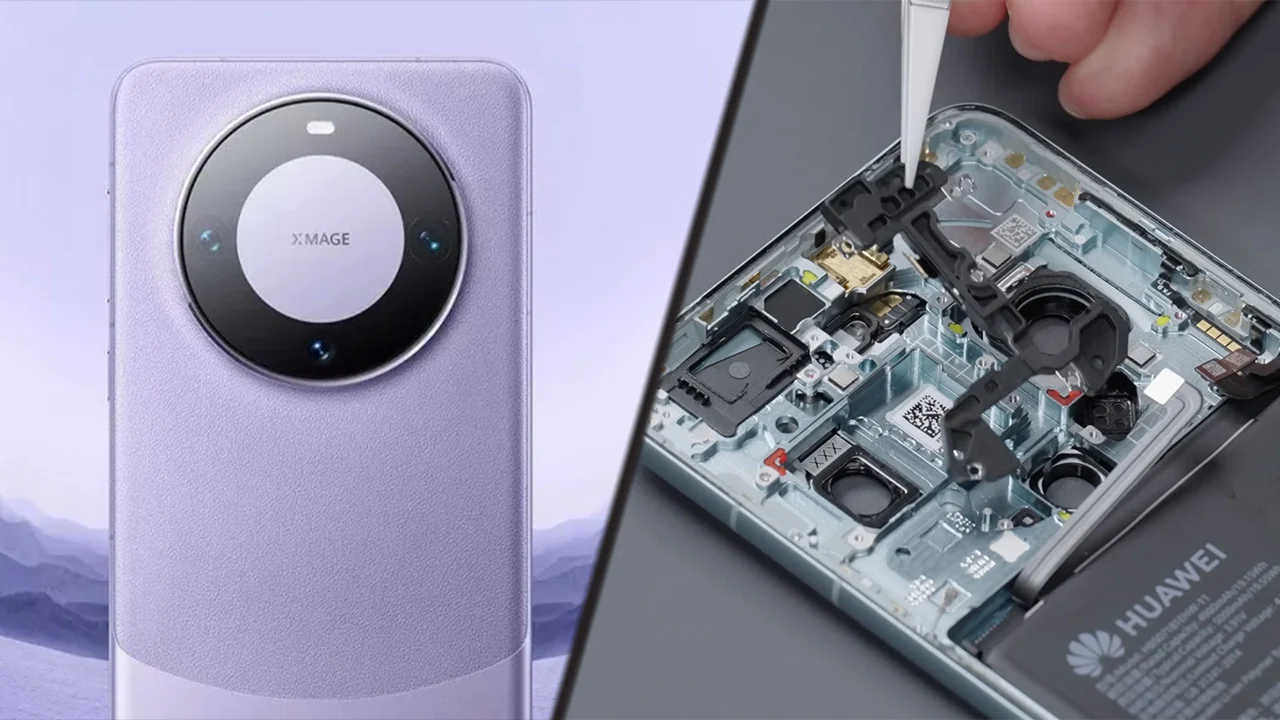
Start with what China has genuinely achieved, because it is real. In 2023, Huawei stunned Western analysts with a 7nm chip inside the Mate 60, the Kirin 9000S. In 2025 it went further, with the Kirin 9030 in the Mate 80 Pro Max, which the teardown firm TechInsights judged very close to a true 5nm-equivalent node. Both were manufactured by China's SMIC. Both were impressive. And, crucially, both were made without EUV at all, by pushing older DUV machines through punishing multi-pass workarounds.
That points to a quieter, more important fact. Export controls blocked China from EUV, but not from much of ASML's DUV range, and China has been buying it as fast as it can. By one accounting, seventy percent of ASML's DUV sales in 2024 went to China. The strategy is to squeeze 5nm-class results out of DUV through sheer volume and effort, accepting lower yields as the price of independence.
On the holy grail, a domestic EUV machine, China has mounted a serious, coordinated national effort. Reuters has described a web of more than three thousand researchers: the Harbin Institute of Technology working on the light source, the Changchun Institute of Optics on the mirrors, SMEE on integrating the whole system, with Huawei and the state-backed firm SiCarrier coordinating. Notably, they are not copying ASML's approach but trying a different one, generating EUV with a laser-induced discharge plasma rather than ASML's laser-produced plasma. There are reports of prototypes and of light sources reaching 100 to 150 watts, with bullish claims of mass production as soon as 2026 and a 2nm node by 2028.
And here is a detail that complicates the simple "China versus the West" frame: ASML's monopoly is not only under siege from Beijing. A Peter Thiel-backed American startup called Substrate is also trying to build a rival. Fouquet's verdict on them was just as dismissive: "far from building a viable rival." The wall, in other words, is steep for everyone, friend and rival alike.
FIG. 4 / CHINA'S CLIMB: THE CLAIM VERSUS THE CATCH
10 / the verdict: a fragile empire
The verdict: a fragile empire
The ASML story carries two lessons that outlast any single chip, and they pull in opposite directions.
The first is hopeful, and almost old-fashioned. Real innovation rewards patience. While rivals chased the next quarter, ASML poured twenty years and a fortune into a dream the smart money had written off, and that lonely bet bought them a fortress no one has been able to storm. There is a quiet rebuke to short-termism in that, and it is worth remembering the next time a company promises a revolution by next year.
The second lesson is the unsettling one. Our entire digital civilisation now balances on an alarmingly thin set of points: one town in the Netherlands, one mirror maker in Germany, one dominant foundry cluster in Taiwan, and a web of specialist suppliers holding it all together. A fire in Veldhoven, an earthquake off Taiwan, a political crisis at the wrong moment, any of these could slow the planet to a crawl. We saw a gentle preview during the pandemic chip shortage, when missing components idled car factories worldwide. ASML's monopoly is, at once, a triumph of engineering and a single point of failure for the modern world.
So can China break it? Not soon, and not certainly. The honest reading of the evidence is that Beijing has made real progress on pieces of the puzzle and assembled a serious national effort, but that a machine to rival ASML is still years away and far from guaranteed. The hype outruns the silicon in both directions. What is certain is that a world this dependent on one machine is right to be nervous, and that the contest over who gets to build the next one will shape the decade more than almost anything else in technology.
ASML built a fortress so complete that the world cannot live without it, and cannot quite feel safe with it. That is the strange, brilliant, precarious position of the most important company you have never thought about.
11 / questions, answered