
ASUS ROG at Twenty: The Republic That Copper Built
From a copper-clad motherboard in a 2006 Taipei lab to phones, handhelds, and the heart of PC gaming, this is how ASUS ROG built the Republic of Gamers, and where its bet goes next.

In 2006, in a lab beneath an R&D building in Taipei, a small team of motherboard engineers was bolting a slab of pure copper onto a circuit board and arguing about BIOS menus. They were not trying to build a better motherboard. They were trying to build the first one designed, from the ground up, for the people who push hardware until it screams. Twenty years later that idea lives in your laptop, your phone, your backpack, and on the stage at sold-out tournaments. It started as a single board called Crosshair. It became a republic.
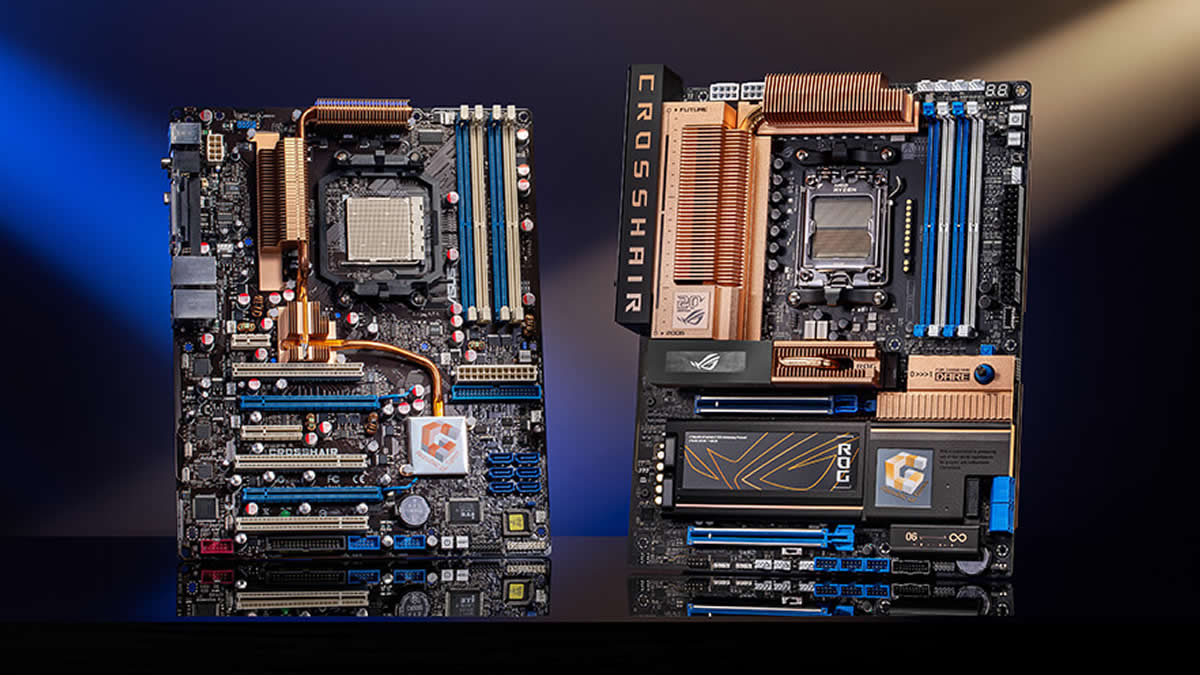
- 2006ROG Crosshair, the first board. AMD Socket AM2, a tall copper heatsink, a tweaker's BIOS.
- 2007 to 2008The Eee PC kicks off the netbook era while ROG climbs; ASUS splits its factory arm into Pegatron.
- 2008The first ROG laptop. Motherboard cooling know-how moves into the chassis.
- 2014ROG Swift PG278Q, 144Hz and NVIDIA G-Sync, helps redefine the gaming monitor.
- 2017ROG Zephyrus GX501 and its lid-lifting cooling trick make a thin gaming laptop credible.
- 2018ROG Phone, a phone built around landscape play and a clip-on fan.
- 2023ROG Ally takes the handheld PC fight to Valve's Steam Deck.
- 2025ROG Xbox Ally, built with Microsoft, finally answers the Windows-on-a-handheld problem.
- 2026ROG Crosshair 2006 closes the circle: a modern flagship dressed as the original board, for ROG's 20th.
A slab of copper, and a manifesto
Rewind to what 2006 actually felt like. Half-Life 2, Far Cry, and Oblivion were punishing graphics cards, multi-core processors were going mainstream, and players wanted more out of their machines than they ever had. The motherboard team did not respond by tuning an existing board a little. They rebuilt power delivery from the trace level up, used tougher components, rerouted signal paths, and tuned the whole design to stay stable when a chip was being shoved far past its rating.
But hardware was only half of it. Before launch, the team did something a little radical for the time. They pulled well-known overclockers and serious gamers into development, the kind of people who test a board not in a clean lab but at the cruelest edge of real use. Their feedback reshaped the BIOS, the low-level software that runs the board, around what those users actually needed: deep enough for an expert to fine-tune every voltage, and simple enough for a newcomer to gain a few hundred megahertz with one trip into a menu. That habit, building with the community rather than at it, got stamped into ROG's DNA, and it became one of the things that set the brand apart.
The product was the ROG Crosshair, built for AMD's Socket AM2 and the dual-core Athlon 64 era. ASUS did not ship it under the main brand. It minted a whole new sub-brand: Republic of Gamers. The name was a deliberate piece of theatre. In 2006, gamers were not at the center of the PC industry. Alienware existed, Razer existed, the overclocking scene existed, but gaming hardware was still a side room. "Republic" was a flag planted for the people willing to dare, a promise that their battle scars were a badge of honor and not a warranty problem.
Then there is the culture ROG bolted itself to. In extreme overclocking, enthusiasts pour liquid nitrogen onto a processor, chilling it toward -196 degrees Celsius to hold a record clock speed for a few brilliant seconds. Call it the motorsport of hardware: impractical, spectacular, and the place where the real limits get found. ROG became one of its most visible backers, supporting competitions, turning up in record attempts, and feeding what it learned at the edge straight back into boards ordinary people could buy. The formula was set early, and it never really changed: engineers who love pushing limits, a community kept in the loop, and a flat refusal to accept the normal ceiling on what gaming hardware could be.
Two roads out of Taipei
By 2007, two very different futures were pulling at ASUS at once. On one side sat the Eee PC: tiny, cheap, accessible, the little machine that kicked off the netbook craze. On the other sat ROG: expensive, powerful, boundary-pushing, and speaking straight to gamers. Put side by side, they exposed a genuine identity question for the company.
Because ASUS was living a double life. It sold its own branded products, and at the same time it was a contract manufacturer building hardware for HP, Dell, Sony, and Apple. It was on stage selling to you and, behind the curtain, building the set for its rivals. That tension finally resolved around 2008, when ASUS split itself in two. The company would focus on its own brand, and the manufacturing arm became Pegatron.
For ROG, the breakup was unexpectedly good news. ASUS was no longer mainly a factory for other people's products. It was a company that needed its own brands to matter, and of all of them, ROG had the sharpest, most distinct identity. The pieces were in place. The motherboard label was ready to leave the motherboard behind.
From inside the case to on the desk
In 2008, ROG shipped its first laptop, the start of the G series. Back then "gaming laptop" mostly meant a giant chassis, gaudy lighting, and a brutal price. The early G models were more restrained, but ASUS carried one decisive advantage out of the motherboard business: thermal engineering. Cramming a strong processor and graphics chip into a thin shell and keeping it cool is the hardest problem in the category, and ROG already knew how to move heat. That inheritance would stay one of its strongest cards for years.
Then the audience changed. Around 2011, with League of Legends, Dota 2, and the rise of Twitch, gaming stopped being only something you played and became something you watched. Suddenly the hardware itself was visible. People wanted to know exactly what monitor, keyboard, and PC the pros were on. ROG rode straight up that wave. Across the early 2010s its range expanded aggressively into monitors, mice, keyboards, headsets, and later routers, with Aura Sync lighting tying it together so a whole desk could glow in one coordinated identity. ROG stopped being a label hidden inside a case and became a signature sitting on top of the desk.
From a single motherboard in 2006, ROG branched into nearly every surface a gamer touches.
In 2014, the ROG Swift PG278Q helped change what a gaming monitor even was, pairing a 144Hz refresh rate with NVIDIA G-Sync. Here is what that number does in practice: a standard panel redraws the screen 60 times a second, while 144Hz redraws it far more often, so motion looks smoother and the display answers your input faster. For a competitive player, that gap is the millisecond between landing the shot and watching the kill cam. It also stoked an appetite for ever-faster graphics cards to feed those panels, the same arms race that runs through our review of the RTX 5090.
None of this happened in a vacuum. By 2014 and 2015, gaming hardware was no longer niche; it was a billion-dollar industry, and the rivals crowded in. MSI pushed hard in laptops, Razer built itself into a lifestyle brand, Corsair and Logitech carved up peripherals, and Alienware came back swinging with Dell's resources behind it. To stay ahead, ROG could not just make good products. It had to keep changing what gamers expected, and that pressure set up the next fight.
Why does gaming power have to be this heavy?
Picture an airport in 2016. One of ROG's marketing leads is dragging the flagship of the day, the ROG G752, through terminals and transfer corridors and finally wedging it into a cramped overhead bin. The thing weighs 4.4 kilograms. Somewhere over the Pacific, slumped in a seat with aching shoulders, he is stuck on the basic contradiction of the gaming laptop: there was plenty of power, and almost no portability. The question that followed him home was simple, and a little angry. Why does gaming power have to be this heavy?
Back in Taipei, the team turned that flight into an engineering brief: desktop-class performance in a chassis around 2 kilograms. Physics pushed back hard. Strong silicon makes heat, and dumping heat wants big fans and fat copper pipes, which means weight and bulk, which is exactly what you were trying to lose. A vicious little circle.
The answer walked on stage in Las Vegas in 2017: the ROG Zephyrus GX501, by ASUS's account one of the thinnest high-performance gaming laptops of its moment, around 17.9 mm thick and roughly 2.2 kilograms, with an NVIDIA GeForce GTX 1080 Max-Q and an Intel Core i7 inside. The clever part hid underneath. ASUS called it the Active Aerodynamic System: when you opened the lid, the bottom panel dropped a few millimetres, opening a vent that let air flow straight into the cooling. A chassis that breathed from below ran as much as 10 degrees Celsius cooler than one sitting flat.
Open the lid, the base drops a few millimetres, and the cooler finally gets to breathe.
That is what engineers mean by an elegant solution: a hard problem solved with a simple, almost mischievous bit of mechanical design. Zephyrus was not just a thin laptop, it was a direction. The old law of the category, if you want power you carry weight, was suddenly up for debate, and rivals followed within a couple of years with thinner machines of their own. ROG's cooling heritage from the motherboard days gave it a real head start in that race.
The laptop line then settled into a clear ladder. Zephyrus stood for thin and premium, Strix and Strix Scar for raw performance and esports, and TUF Gaming for the more affordable, durability-first end. Instead of one confusing flagship, ASUS offered a staircase you could pick a step on, by budget and by how you actually played.
A phone, a tablet, and a leap into your palm
In 2018, at Computex, ASUS revealed the ROG Phone. The gaming-phone idea was barely a year old, Razer had probed it and Xiaomi's Black Shark was chasing it in China, and most attempts amounted to a normal phone with a few extra features bolted on. ROG went the other way and designed around the way people actually game on a phone: held sideways, for long sessions. So it shipped a binned, higher-clocked Snapdragon 845, a 90Hz AMOLED screen when most phones were stuck at 60, a USB-C port moved to the side so a cable would not jab your palm in landscape, and a clip-on AeroActive Cooler fan.
The logic was the founding philosophy ported to a new device: take an existing category, redesign it through a gamer's eyes, and push the limits, exactly what the Crosshair had done to the motherboard. But the phone market was a different animal, ruled by Apple and Samsung, and ROG Phone stayed a niche product that never chased iPhone or Galaxy numbers. Strategically, though, it proved something that mattered. ROG could leave the PC desk and survive out there.
It kept pushing on form. The 2022 ROG Flow Z13 put an RTX 30 graphics solution into a tablet with a detachable keyboard, openly poking at the line between tablet and gaming PC. It was not the right machine for everyone, but it made the point that ROG refused to be boxed into the classic laptop shape.
And then the boldest move of all. In 2021, Valve's Steam Deck dragged handheld PC gaming into the mainstream and asked the question the whole industry suddenly had to answer: can real PC games fit in your palm? ASUS's reply would become the most talked-about, fastest-changing, and most controversial device in ROG's history.
The Ally, an April Fools' joke that was real, and a wound ROG gave itself
It landed on 1 April 2023, the internet's least trustworthy day. ASUS ROG posted a video of a white handheld called the ROG Ally, and the comments did exactly what you would expect: nice prank, almost had me, nobody launches a product on April Fools. Then ASUS confirmed it was real. The timing was either a marketing masterstroke or the unluckiest calendar choice in tech history, and it was probably both.
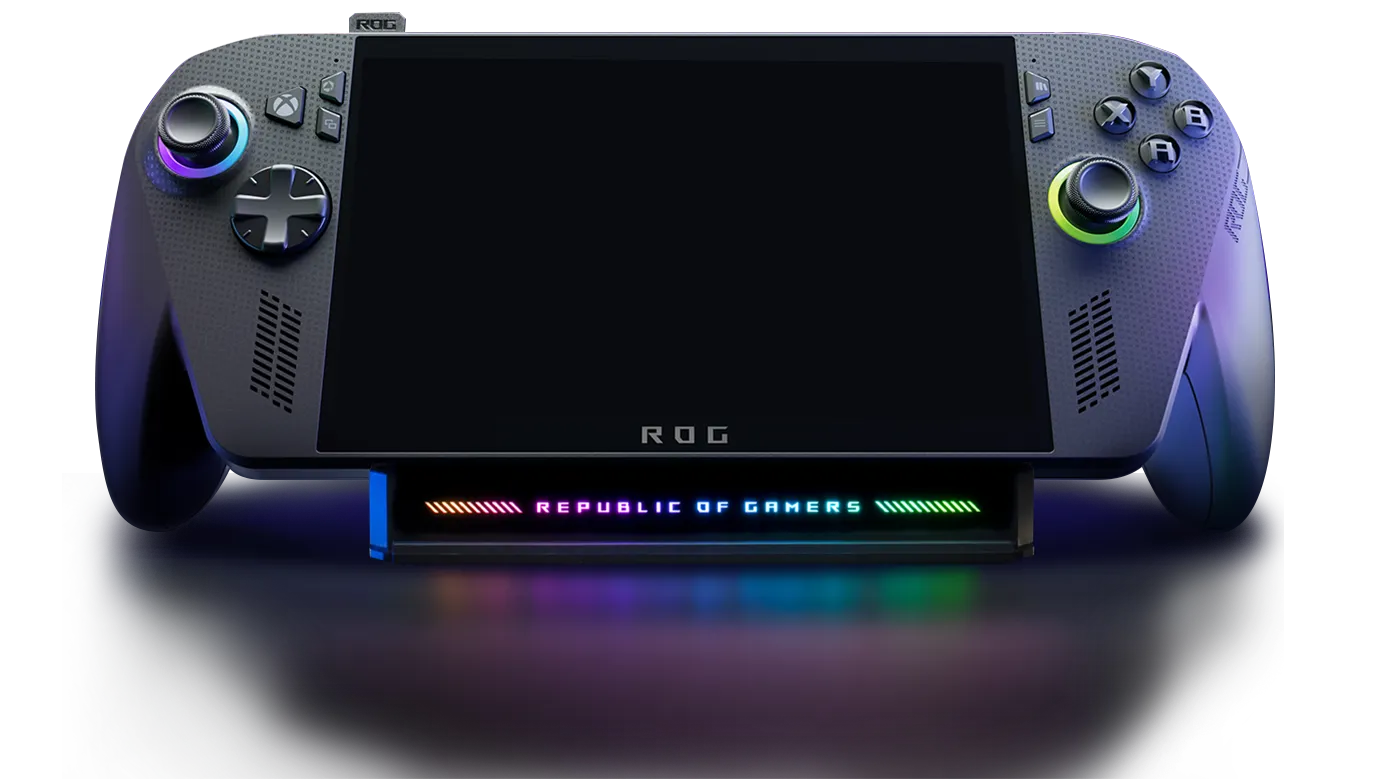
The Ally itself was serious. A 7-inch Full HD touchscreen at 120Hz, powered by AMD's Ryzen Z1 Extreme, a chip that fused Zen 4 processor cores with RDNA 3 graphics in a single package, which is ambitious power for something you hold in two hands. It shipped on 13 June 2023 at 699 US dollars and went straight at the Steam Deck. The two machines were really two philosophies wearing plastic shells.
Total freedom, with a tax
- Steam, Xbox Game Pass, Epic, Battle.net, emulators, mods, desktop apps
- Any storefront, any program you can install on a PC
- The tax: Windows 11 is clumsy on a small touchscreen and heavier on the battery
Consistency, by design
- A console-like flow: open it, your library is right there, play
- A tuned, predictable experience built around one storefront
- The trade-off: a more closed, Linux-based platform and a compatibility layer
The Deck ran Valve's Linux-based SteamOS: more consistent and console-like. The Ally ran full Windows, which meant total PC freedom, but that freedom carried a tax. Windows 11 was never designed for a small touchscreen. Menus were tiny, finger navigation was fiddly, and background tasks chewed through the battery. Early reviews split right down that seam: the performance and the screen drew praise, the Windows experience drew the complaints.
Then the trouble turned physical. Soon after launch, owners reported microSD card reader failures, some saying the reader had stopped working, some saying their cards were being damaged. The reader sat too close to the hot zones inside the device. In July 2023, ASUS acknowledged that the reader could misbehave under high temperatures and adjusted how it handled the issue in service.
A brand's strength is not measured when the hardware works. It is measured when it breaks.
Here, ROG's hardware shone and its support did not, and the brand paid for it in exactly the currency it cares about most: the trust of the people it was built for. To its credit, ASUS answered with the product as well. At Computex in mid-2024 it launched the ROG Ally X, not a new generation but a thorough rework. It roughly doubled the battery, raised memory to 24GB, moved to a common M.2 2280 storage slot, and crucially relocated the microSD reader away from the heat. It kept the original idea and quietly fixed the parts early buyers had hated.
In June 2025, at the Xbox Games Showcase, a familiar device appeared wearing an unexpected logo: Xbox. ASUS and Microsoft revealed the ROG Xbox Ally line. The standard model runs an AMD Ryzen Z2 A, while the premium ROG Xbox Ally X runs the Ryzen AI Z2 Extreme, an eight-core Zen 5 part with sixteen RDNA 3.5 graphics cores and an on-chip NPU for AI features. But the real move was software, not silicon. Instead of dropping you onto the Windows desktop, Microsoft built a streamlined, console-like front end that takes you straight into games, with Game Pass woven in, an Xbox button, and impulse triggers, making a device that is technically a PC feel much closer to a console.
| Spec | ROG Xbox Ally | ROG Xbox Ally X |
|---|---|---|
| Processor | AMD Ryzen Z2 A (Zen 2) | AMD Ryzen AI Z2 Extreme (Zen 5) + NPU |
| Memory | 16GB LPDDR5X | 24GB LPDDR5X |
| Storage | 512GB | 1TB |
| Battery | 60Wh | 80Wh |
| Display | 7-inch FHD, 120Hz | 7-inch FHD, 120Hz |
| Launched | 16 Oct 2025 | 16 Oct 2025 |
Read that carefully and you see the cleverness. The single loudest criticism of the original Ally, that Windows was the wrong skin for this form, was answered by Microsoft itself. The series launched on 16 October 2025, and for ROG it was a strategic turning point, not just another handheld but a far tighter alignment with Microsoft's gaming ecosystem. When Xbox's software met ROG's hardware engineering, the result was neither a classic PC nor a traditional console but something deliberately in between, and that is a hint about where this is all heading: the devices keep diverging while the ecosystems keep converging.
How a motherboard brand ended up on a tournament stage
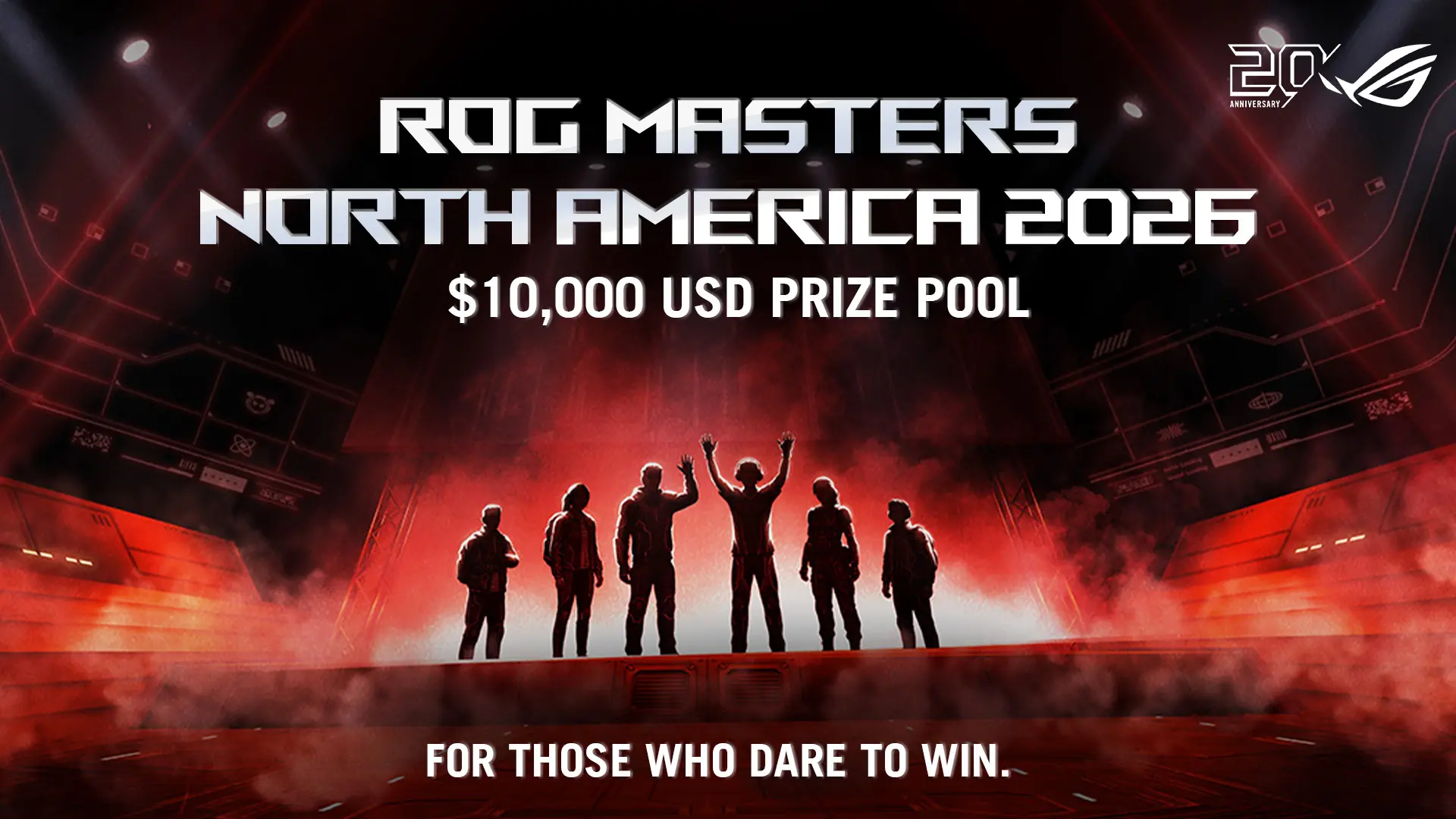
All of that expansion only means something if the gear shows up in gamers' real lives, in tournaments and on streams, not just on spec sheets. ROG understood that early. In 2017, in Las Vegas, Echo Fox, the esports organisation founded by former NBA star Rick Fox, announced a multi-year deal with ASUS ROG, kitting its teams out with desktops, laptops, monitors, mice, and more. A three-time NBA champion standing shoulder to shoulder with a gaming-hardware brand was a loud signal that gaming had shed its old kids'-hobby image.
Five years earlier that scene would have been unthinkable at this scale. But by 2017 the League of Legends World final drew more than 60 million viewers, and the prize pool for Dota 2's International had passed 24 million US dollars. Counter-Strike events were filling arenas, and Twitch was pulling millions of simultaneous viewers. Esports was no longer a curiosity; it was a billion-dollar industry, and ROG was one of the hardware brands that planted itself there early.
The Echo Fox deal also marked a shift in what sponsorship even meant. It moved past slapping a logo on a banner toward being part of the kit pros actually trained and competed on. ROG kept widening the net from there. The ROG Academy, launched in India in 2021, set out to find amateur talent and push it toward the pro stage, starting with Counter-Strike and adding coaching and equipment to the mix. Partnerships with pro teams, university programs, and creators followed, including more recent deals with organisations like Team Vitality.
The throughline is subtle, but it is the whole point. For ROG, esports was never just a marketing channel. It was a way to live inside a gamer's memory, reached not from a billboard but from a favourite team's jersey, a streamer's desk, and the monitor glowing on the tournament stage. It is the 2006 Crosshair idea, build with the community, grown all the way up into the esports era.
Twenty years on, and the floor shifts under everyone
In 2026, ROG turns twenty, and gaming is changing shape again: artificial intelligence, cloud gaming, new device forms, new habits. To mark the anniversary, ASUS made a telling choice. It went back to the beginning. In May 2026 it announced the ROG Crosshair 2006, a flagship X870E board for AMD's AM5 socket, dressed as a love letter to that first Crosshair: a dominant copper colour with touches of white and blue, and a 2-inch OLED on the top M.2 slot running two animations, one honouring the original board and one celebrating the twenty years.
| The original Crosshair (2006) | ROG Crosshair 2006 (2026) | |
|---|---|---|
| Socket / platform | AMD Socket AM2 | AMD Socket AM5, X870E |
| The look | Pure copper heatsink, white and blue | Copper-coloured cooler, white and blue |
| Display | None | 2-inch customisable OLED |
| Tuning story | Overclocking BIOS, shaped by the community | AI-assisted tuning, plus deep manual control |
| Price | A 2006 enthusiast board's price | $799.99 |
| The point | Establish a new gaming brand | Celebrate twenty years of it |
Hold the two boards side by side and you can measure how far the ground has moved. When ROG launched in 2006, there was no iPhone, YouTube was a year old, Twitch did not exist, cloud gaming sounded like science fiction, and AI was not the everyday tool it is now. If you could carry a PC gamer from 2006 forward to today, the leap would feel as large as the one from the home computers we wrote about in our history of the Commodore Amiga 500 to a modern battlestation. Today gaming is a roughly 200 billion dollar global business, not just entertainment but hardware, software, publishing, esports, subscriptions, and creators, a whole cultural economy that reshapes itself every single year.
ROG's first big headline at twenty is AI. The wave that became visible when ChatGPT arrived in late 2022 has rewired hardware. NVIDIA's GPUs no longer just draw pixels; they train and run AI models, a shift so complete that we argued it had stopped being a graphics company at all in our piece on NVIDIA's reinvention. AMD and Intel are handing more die area to NPUs. ASUS leaned hard into the AI PC idea across 2024 and 2025, and on the ROG side, features like AI overclocking, AI cooling, and AI networking aim to read how the processor, the thermals, and the network traffic behave and then tune the system automatically.
That can sound like marketing garnish, but it marks a real shift in posture. For years ROG handed its users granular control: voltages, fan curves, frequencies, memory timings, the levers an expert pulled to push a system to its edge. Now AI quietly automates part of that expertise. A player who knows nothing about voltage regulation or thermal dynamics can still coax more out of their machine. It is the exact point where the old overclocking culture meets the new AI PC era: the mastery does not vanish, but the threshold to start drops hard.
The second headline is that gaming devices no longer live in one shape. The real question is not only what a gaming PC is, but which device a player wants in a given moment, for a given experience, and ROG's future will likely orbit that question: a family that adapts to your different moments rather than a single flagship to rule them all. The deepest question, though, is about the game itself. Cloud gaming, the model Google Stadia failed to crack but NVIDIA's GeForce Now and Xbox Cloud Gaming have grown step by step, reopens the oldest argument of all: how much hardware do you really need in your hands? If a game runs on a powerful server and only streams to your screen, the raw power you are holding matters less. For a brand that sells high-performance hardware, that is a direct strategic tension, and it is exactly why ROG's move closer to Microsoft through the Xbox Ally reads as more than a device partnership. It is a position on where gaming will actually run.
And at the bleeding edge of the hardware story sits the Strix Scar, carrying the newest ROG Nebula HDR display, what ASUS calls the world's first 18-inch 4K 240Hz mini-LED laptop panel, fusing high resolution and a high refresh rate with vivid HDR. We will take that "world's first" with the usual raised eyebrow until the panel is independently put through its paces, but the ambition is real, and it is very on-brand: when in doubt, push the one number nobody else has pushed.
What ROG was actually aiming at
This is not a flawless success story, and it would be dishonest to tell it as one. The high prices, the software complaints, the Ally service crisis: these are the moments where the brand was tested against its own promise, and it did not always pass cleanly. ROG has stayed strong for one reason above the rest. It kept contact with gamer culture at the moments that actually mattered.
From the overclockers who shaped the first Crosshair to esports teams, creators, and ordinary users filing warranty claims, the pattern repeats. Close to gamers, ROG gets stronger. Drifting away from them, it takes its harshest criticism from those very same gamers. The Gamers Nexus episode was exactly that: the people ROG exists for, holding it to account and forcing it to be better.
Maybe ROG's biggest achievement is the one no product page states plainly. It started as a motherboard series and became a mark recognised on gamers' desks, in their bags, in their pockets, and on the tournament stage. The first board was called Crosshair, the aiming reticle, the point you fix on before you take the shot. Twenty years on, the target was never simply higher frame rates, cooler chips, or brighter RGB.
The target was building a world gamers could see themselves inside. The name said it from the very start. Republic of Gamers.
Frequently asked questions
What does ROG stand for, and when did it start?
ROG stands for Republic of Gamers, the gaming sub-brand of ASUS. It launched in 2006 with the ROG Crosshair motherboard, built for AMD's Socket AM2 and the dual-core Athlon 64 era.
What was the first ROG product?
The ASUS ROG Crosshair motherboard (2006). It was known for its tall copper heatsink and an overclocking-friendly BIOS that ASUS shaped with feedback from the enthusiast and overclocking community.
What is the ROG Xbox Ally?
A handheld gaming PC built by ASUS with Microsoft, launched on 16 October 2025. It runs an Xbox-style full-screen interface instead of the standard Windows desktop, with Game Pass built in. The standard model uses an AMD Ryzen Z2 A and the higher-end Ally X uses the Ryzen AI Z2 Extreme.
What is the ROG Crosshair 2006?
A 20th-anniversary motherboard announced in May 2026. It is a modern AM5 and X870E flagship styled after the original 2006 Crosshair, with a copper colour scheme, white and blue accents, and a 2-inch OLED, priced at 799.99 US dollars.
Is ASUS ROG worth the premium?
ROG's engineering, especially its cooling, is genuinely strong, and its hardware often leads its category. But it is premium-priced, and the 2024 warranty controversy exposed real after-sales weaknesses that ASUS had to publicly fix. Buy with open eyes: excellent when it works, and worth checking local support quality before you spend.