
01 / The pitch from the stage
The pitch from the stage
Jensen Huang holds hardware the way a magician holds a dove, as though it had just been smuggled in from a future the rest of us are not yet cleared to visit. At Computex 2026, on the stage of the Taipei Music Center, the thing in his hand was not a graphics card and not a phone. It was a whole computer collapsed onto a single sliver of silicon, and he called it the first PC rebuilt from the ground up in forty years, a leap he set beside the day the telephone grew a screen and a brain and became the thing that now runs your life from your pocket.
The product is the NVIDIA RTX Spark, and the boast is not a modest one. The PC, the machine we have loved and sworn at and pried open and upgraded for four straight decades, has supposedly just been redrawn from the transistor up by the most valuable company on Earth. If a startup made that claim you would smile politely and drift toward the exit. When NVIDIA makes it, you sit back down, because this is the one company that has turned inventing a category nobody asked for and then quietly owning it for twenty years into a personality trait.
So we sat down and listened. And then we asked the three questions the keynote was very careful to leave hanging in the dark: reinvented for whom, at what price, and to cure a problem that how many of us have ever actually had?
02 / What you are buying
What you are actually buying
Peel the bunting off the announcement and the RTX Spark turns out to be a familiar idea in a sharp new suit: a system on a chip, the same trick that runs the phone in your pocket, scaled up and aimed point blank at Windows. NVIDIA did not even build it alone. MediaTek supplies the brain, a twenty core Arm processor, NVIDIA bolts its own Blackwell graphics in beside it, as many as 6,144 cores, and then it fuses the two to as much as 128GB of shared memory and welds the whole thing shut. Processor, graphics and memory, melted into one slab. There is no socket to upgrade, no card to swap, no stick of RAM to add at two in the morning the day you finally scrape the money together. You buy the entire brain on day one, exactly as it is, for as long as you own it. For a machine whose forty year legend was built on being the one thing you could crack open and change, that is a quietly radical act of confiscation.
Now ignore the numbers printed on the box, because the ones that matter are hiding right behind them. The graphics land somewhere near a mobile RTX 5070, which is a startling amount of muscle for something this thin, and NVIDIA swears it will run a modern blockbuster like Indiana Jones and the Great Circle at 100 frames a second at 1440p, on battery, inside a shell fourteen millimeters thick. Read that last part twice, because it is the entire magic act: on battery. It is also, a little awkwardly, the exact trick Apple pulled off six years ago and has been compounding in silence ever since. The number NVIDIA actually wants burned into your memory is the other one, the 128GB of unified memory and the petaFLOP of low precision math, the two figures that let this machine do the single thing the whole launch was built to sell: run a serious AI model right there on your desk, with the internet switched off.
If all of that is ringing a bell, trust the bell. This is, almost transistor for transistor, the same GB10 silicon NVIDIA has been quietly selling since October 2025 as the DGX Spark, a four thousand dollar AI appliance for developers. The RTX Spark is that chip with a fresh haircut, an HDMI port and a battery, turned to face you and me. Nothing here was conjured into being for Computex. A developer tool put on a good shirt and was reintroduced as the future of personal computing, and whether that lands as audacious or faintly cynical depends entirely on the one number NVIDIA still refuses to say out loud. Which brings us, as these stories always do, to the price.
03 / The promise
The promise: your own AI, with the cloud switched off
Said quickly enough, the pitch is intoxicating. Pack 128GB onto the chip and an RTX Spark can hold an AI model of roughly 120 billion parameters entirely in its own memory, no cloud required, and at that very same week's Microsoft Build the two companies revealed the missing half: a version of Windows engineered to run personal AI agents in a locked box on hardware you own, NVIDIA's runtime humming underneath. The phrase Satya Nadella reached for was intelligence in every home and on every desk, with nothing ticking on a meter. No subscription. No data slipping out the door. An assistant that answers to you and to nobody else.
For one very particular kind of person, this is not a feature list, it is a fantasy made flesh. If your days are spent around medical records, legal files, or anything that would land a compliance officer in the hospital, then "the data never leaves the room" is not a nicety, it is the whole job. If you live where the signal goes to die, or you simply refuse to let a stranger meter your every passing thought, a private model running on silicon you own carries a real and deeply unfashionable dignity. NVIDIA is entirely right that all of this now fits in a bag you can sling over one shoulder. The trouble is that "can" was never the interesting word. The interesting word is "should," and the instant you ask it, the question stops being about engineering and turns, ruthlessly, into a question about money.
04 / The cloud did the math
The cloud quietly did the math first
Here is the sentence the keynote tiptoed straight past. The most powerful model you can cram onto a four thousand dollar machine is still, on its very best day, a model the frontier waved goodbye to a season ago. The systems people actually want, the flagship GPT and Claude Opus and Gemini and MiniMax and Qwen, are vastly larger, vastly better fed, and improving on a cadence your sealed little box has no hope of keeping pace with. You can buy the finest AI computer that will ever sit on a desk and still find yourself running last year's runner up.
Let me incriminate myself, because my own setup quietly demolishes the entire premise. At home I run a tiered router, and there is nothing exotic about it. A service like OpenRouter hides hundreds of models behind a single key, and the instruction I hand it is almost insultingly simple: fling the easy ninety percent of everything at something small and cheap, and only when a request is genuinely hard does it get escalated to a heavyweight like Opus or GPT. I pay by the token, only for what actually runs, and when the month ends the bill is the price of two flat whites. In exchange I get the best models on the planet, on tap, upgraded while I sleep without my having to notice. To rebuild even a thin slice of that at home, I would hand over thousands of dollars for a machine running a weaker model that improves more slowly and becomes a paperweight the morning the next flagship lands.
And yet I refuse to call local AI pointless, partly because the house style I write to forbids the cheap shot, and partly because it would simply be wrong. Local wins, and wins decisively, in the cases that actually earn it: when the data is legally barred from leaving, when there is no connection to lean on, when latency must be carved to the millisecond, or when you run one fixed job at such monstrous volume that the metered cloud bill finally climbs past the cost of owning the iron outright. For the tinkerer and the researcher, cradling the whole stack in your own hands is a quiet thrill all its own. But for the vast, ordinary crowd this launch was aimed at, the honest verdict stings: the cloud already solved this, for pocket change, and the RTX Spark is a beautifully engineered cure being sold to people who were never sick.
05 / An industry that runs on price
Building a PC is an industry, and it runs on price
It is easy, in the warm glow of a keynote, to forget that the PC is not a gadget at all. It is an industry, and the secret behind the most successful machine in human history is also the dullest thing about it: you can build one for almost any sum of money you happen to have. The IBM PC, and the sprawling Windows on Intel empire that grew out of it, did not win on elegance. It won because it was open. Anyone could make a part. Every part had to claw at every other part on price. A broke student and a flush studio could each walk out with a machine that fit, ten times apart in cost, running the very same software. That is not a footnote to the story. That is the whole miracle.
The system on a chip takes that miracle out behind the building. Fuse the processor, the graphics and the memory into one sealed brick and it is NVIDIA, not you, that decides the configurations, the tiers and the floor price, and your only move left is to accept the menu as written. On a phone, fine, nobody ever expected to open it. On the machine that spent forty years being the one thing you could bend to the precise shape of your own wallet, it is a far harder thing to swallow. And the timing borders on cruel: the RTX Spark walks on stage in the middle of a genuine memory shortage, DRAM and flash prices marching upward by the week, into a market so tight that even Apple just quietly jacked up its cheapest Mac mini and quietly executed its smallest storage tier to protect a margin.
Look at what is actually winning the year and the contrast turns almost cruel. Apple's runaway hit is not a four thousand dollar AI box nobody asked to carry. It is the MacBook Neo, five hundred and ninety nine dollars, four ninety nine if you are a student, running a chip lifted clean out of an iPhone, and it is flying off shelves faster than Apple itself dared to forecast, for the gloriously unglamorous reason that it does everything a normal human needs a computer to do, beautifully, for the price of a decent phone. That is the lesson the PC has been hammering home for forty years and is apparently still trying to teach the room: the revolution is almost never the most powerful machine in it. It is the good enough machine that everyone can finally afford.
06 / Home turf
The one room where NVIDIA is genuinely home
There is a version of this story in which NVIDIA wins outright, and the funny thing is it has almost nothing to do with AI. It is gaming, the house NVIDIA built brick by brick. Every previous attempt to drag Windows onto Arm, Qualcomm's loudly advertised "AI PC" the most recent casualty, smashed into the same two walls every single time: software written for Intel that stuttered the moment it was translated, and games whose anti-cheat guards took one look at the architecture and bolted the door. The machines themselves were never the problem. The battery life was lovely, the performance perfectly respectable. People simply would not buy them to play, because they flat out could not.
NVIDIA, of all the companies on Earth, is the one with the muscle to kick that second wall down. Buried in the RTX Spark reveal, unglamorous and easy to scroll past, sat the news that actually matters to anyone who games: the popular anti-cheat systems will run natively on Windows on Arm, and the full NVIDIA arsenal, DLSS 4.5 and all, rides along with them. A laptop this thin that lasts all day and still runs the games already sitting in your library, with NVIDIA's upscaling quietly doing the heavy lifting, is a genuinely thrilling object. It is, against the entire run of play, the single most persuasive thing in the whole pitch.
And then the same ghost that haunts the rest of the platform drifts back into the room. How many human beings truly need to push a brand new release to 1440p on a sixteen inch laptop wobbling on an airline tray table? The serious player wants a tower and a monitor and always will. Everyone else already owns a console or a handheld that does the job. The globe trotting enthusiast chasing maximum frames on a dwindling battery absolutely exists, but it is a sliver of a sliver, and NVIDIA pointedly aimed the opening wave at creators and AI buyers rather than at them. The most convincing argument for the entire machine is the one the launch gave the least airtime to.
07 / The human thread
NVIDIA has torn up the rulebook before
It would be a mistake, though, to wave this away, because the company making the boast has a long and uncomfortable habit of doing exactly what it threatens. Wind the tape back to the late 1990s. The king of 3D was 3dfx, its Voodoo cards so untouchable that gamers cheerfully bought a second card, a dedicated accelerator, and bolted it in beside the one that already drew the screen. NVIDIA looked at that absurd two card ritual and decided the extra card simply should not exist. It folded the acceleration onto the graphics card itself, shipped the GeForce 256 in 1999, coined the word GPU for what it had just built, and started hauling work the processor used to do onto its own silicon. 3dfx never caught its breath. NVIDIA bought the corpse, which is precisely why that SLI badge a few of you still remember fondly was, underneath the logo, 3dfx technology wearing a new coat.
NVIDIA is not bulletproof, and that is the part of the story that should keep you honest. The GeForce FX 5800, early in the 2000s, was a hairdryer of a graphics card, loud and hot and genuinely embarrassing, the sort of humiliation that quietly euthanizes a lesser company. NVIDIA shrugged, learned, and kept walking. The real hinge swung in 2016, when it carried an early DGX-1 to a small and faintly strange research lab called OpenAI and simply handed it over, and a bet on AI compute that looked like an eccentric hobby curdled into the most profitable swerve in the history of the industry. A company once worth roughly what a regional phone carrier is worth now clears five trillion dollars, the most valuable enterprise on the planet, and there is no door anywhere marked "back to just making gaming cards."
So, can NVIDIA reinvent the PC? On the evidence of its own life story, yes, eventually, because dreaming up a category and then quietly annexing it is the most fundamentally NVIDIA move there is. But "eventually" is carrying an enormous amount of freight in that sentence. The GPU did not spring into the world fully grown, and neither will this. The RTX Spark is an opening move, not a finished one, and NVIDIA all but confessed as much by unrolling a multi year roadmap of heirs with names like Rubin and Rosa Feynman. This is a forty year bet, laid down in public, on its very first day.
08 / The verdict
The verdict
NVIDIA did not kill the PC at Computex 2026. The mountain did not labour and bring forth a mouse, either. What it did was place an early, expensive, and genuinely ingenious bet on a world where your computer thinks for itself, locally, with nothing ticking over on a meter. The engineering is real. The battery life is real. The gaming story, to my own faint astonishment, turns out to be the realest thing in the entire box. But the headline act, your own private AI humming away on your desk, is a dazzling answer to a question only a small and very specific group of people were ever asking, while the rest of us quietly rent something smarter for the price of a coffee and never give it a second thought.
The revolution is almost never the most powerful machine in the room. It is the good enough machine that everyone can finally afford.
Buy it if
- You handle private or regulated data that is forbidden from leaving your machine
- You need AI that works fully offline, with latency you can predict to the millisecond
- You run the same heavy inference all day, until the metered cloud bill finally bites
- You want a thin, all day laptop that can also game, and you will pay a premium for it
Skip it if
- Your AI use is occasional, general, or already covered by rented models
- You want the most gaming performance per dollar, where a desktop wins every time
- You care about upgrading parts later, or you are working to a tight budget
- You expect the newest, strongest model, which stubbornly lives in the cloud
The PC is not about to walk out of the world it has lived in for forty years, and the reason is almost insultingly dull: that world will sell you a computer for five hundred and ninety nine dollars or for five thousand, and a sealed, premium, all in one chip simply cannot. If AI is your whole reason for being here, you do not need this machine. If you game on the move, watch the second generation like a hawk, because that is the moment NVIDIA's home field advantage stops being a slogan and starts drawing blood. And if you happen to be NVIDIA, none of this keeps you awake at night, because you have already torn up the rulebook of computing twice, and you are plainly in no hurry whatsoever as you reach for the pen a third time.
09 / Questions
Frequently asked questions
What is the NVIDIA RTX Spark?
It is NVIDIA's system on a chip for Windows on Arm laptops and small desktops, revealed at Computex 2026. It fuses a 20 core Arm CPU built with MediaTek, a Blackwell GPU with up to 6,144 cores, and up to 128GB of unified memory into a single package. It is the same GB10 class silicon NVIDIA already sells as the DGX Spark, now repackaged for consumers.
Can it really run AI without the cloud?
Yes. With up to 128GB of unified memory it can hold a model of around 120 billion parameters locally and run personal AI agents under Windows with no connection. But a model that size is still well behind the frontier cloud flagships, so local capability trades raw quality for privacy and independence.
Is it worth it just for AI?
For most people, no. Renting frontier models through a tiered router such as OpenRouter costs cents per session and always gives you the newest, strongest models. Local AI on an RTX Spark earns its keep mainly for private or regulated data, offline use, predictable latency, or very high fixed volume workloads.
Will it replace my gaming PC?
Not your desktop. Its graphics sit near a mobile RTX 5070, and the real news for players is that popular anti-cheat software now runs natively on Windows on Arm, with DLSS 4.5 support. That makes a thin, all day gaming laptop genuinely viable, but a tower with a desktop GPU still wins on raw performance and on price.
When does it launch and how much does it cost?
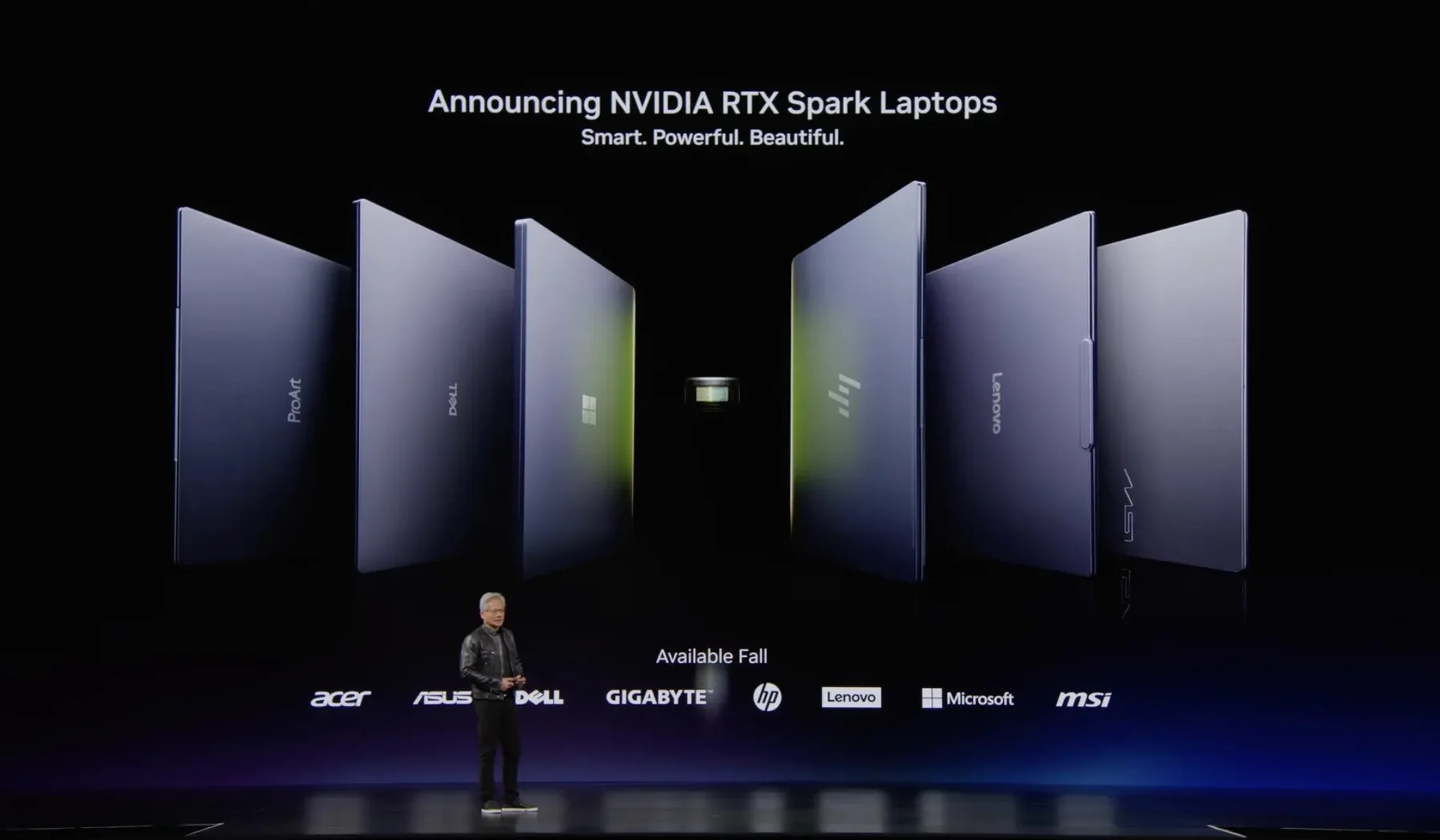
RTX Spark systems from partners such as ASUS, Dell, Lenovo, HP and MSI are due in the fall of 2026, starting in premium creator and AI focused machines. NVIDIA has not announced pricing, and the launch lands during a real DRAM and flash memory shortage that is pushing component prices up.